
In short
- When you are stressed, many people hold tension in the neck, shoulders and jaw.
- Gentle stretching, paired with slow breathing, is an easy way to move and to pause.
- Ten minutes is enough. Move slowly, never into pain, and stop if something hurts.
Why stretching helps on stressful days
Stress shows up in the body. Shoulders creep up towards your ears, your jaw clenches, your back stiffens after hours at a desk or carrying a child. Stretching will not remove the cause of stress, but it gives you two useful things at once: gentle movement and a few minutes of slower breathing.
The World Health Organization recommends that adults do at least 150 minutes of moderate physical activity a week, and notes that any movement is better than none. The NHS includes flexibility exercises among the simple ways to stay active at home. A short stretching routine will not cover all your activity, but it is an easy way to start moving and to take a real break.
Before you start
- Wear comfortable clothes and use a mat or carpet.
- Move slowly and breathe out as you go into each stretch.
- Stretch to a feeling of gentle pull, never pain.
- Hold each stretch for about 20 to 30 seconds, and repeat on both sides.
- If you are pregnant, recovering from an injury or have a health condition, check with a professional first.
The 10-minute routine
| Minute | Stretch | How |
|---|---|---|
| 0–1 | Slow breathing | Sit tall, breathe in for four, out for six, ten times |
| 1–2 | Neck side stretch | Tilt your right ear towards your right shoulder, hold, switch |
| 2–3 | Shoulder rolls | Roll shoulders back slowly ten times, then forward ten times |
| 3–4 | Chest opener | Hands behind your back or on a door frame, open the chest gently |
| 4–5 | Upper back stretch | Arms forward, hands together, round your upper back like a ball |
| 5–6 | Seated twist | Sit tall, turn gently to one side with a hand on the opposite knee, switch |
| 6–7 | Cat and cow | On hands and knees, round your back, then let it dip slowly |
| 7–8 | Child's pose | Kneel, sit back on your heels, arms forward, forehead down |
| 8–9 | Hip flexor stretch | Half-kneel, tuck your hips under and lean forward gently, switch |
| 9–10 | Legs up the wall | Lie on your back with legs resting on the wall, breathe slowly |
A 3-minute version at your desk
No mat, no time? Stay in your chair:
- Breathe out slowly five times, dropping your shoulders on each out-breath.
- Neck side stretch, 20 seconds each side.
- Shoulder rolls backwards, ten times.
- Seated twist, 20 seconds each side, holding the back of the chair.
- Wrist and finger stretch: arm forward, palm up, gently pull the fingers back with the other hand.
Set it as a reminder two or three times a day. It is a small break that also tells your body the alarm can switch off.
When to fit it in
- Mid-morning or mid-afternoon as a break from screens.
- After the school run, before you start work.
- Before bed, as part of a wind-down. Keep it slow and calm.
- When you notice tension: shoulders up, jaw tight, shallow breathing.
A worked example
*This is an illustrative example, not a real user.* Nuria works from home and by 4 pm her neck aches. She sets a reminder for a 10-minute stretch break, does the routine on the living room rug and finishes with legs up the wall. On busy days she only does the first five minutes at her desk. After two weeks she notices she reaches for the routine on her own when her shoulders rise.
Common mistakes
- Bouncing or pushing too far. Slow and gentle is safer and more relaxing.
- Holding your breath. Breathing out slowly is half the benefit.
- Waiting for a free hour. Five minutes counts.
- Stretching through pain. Stop, and get advice if pain continues.
Also useful: A 10-minute home workout for busy days: no equipment, no gym, no excuses needed
When to get help
See a doctor or physiotherapist if you have neck or back pain that lasts, pain that spreads down an arm or leg, numbness or tingling, or pain after a fall or injury. If stress itself feels constant and heavy, talk to your doctor too: stretching helps, but it is not a treatment for anxiety or depression.
 How Senda helps
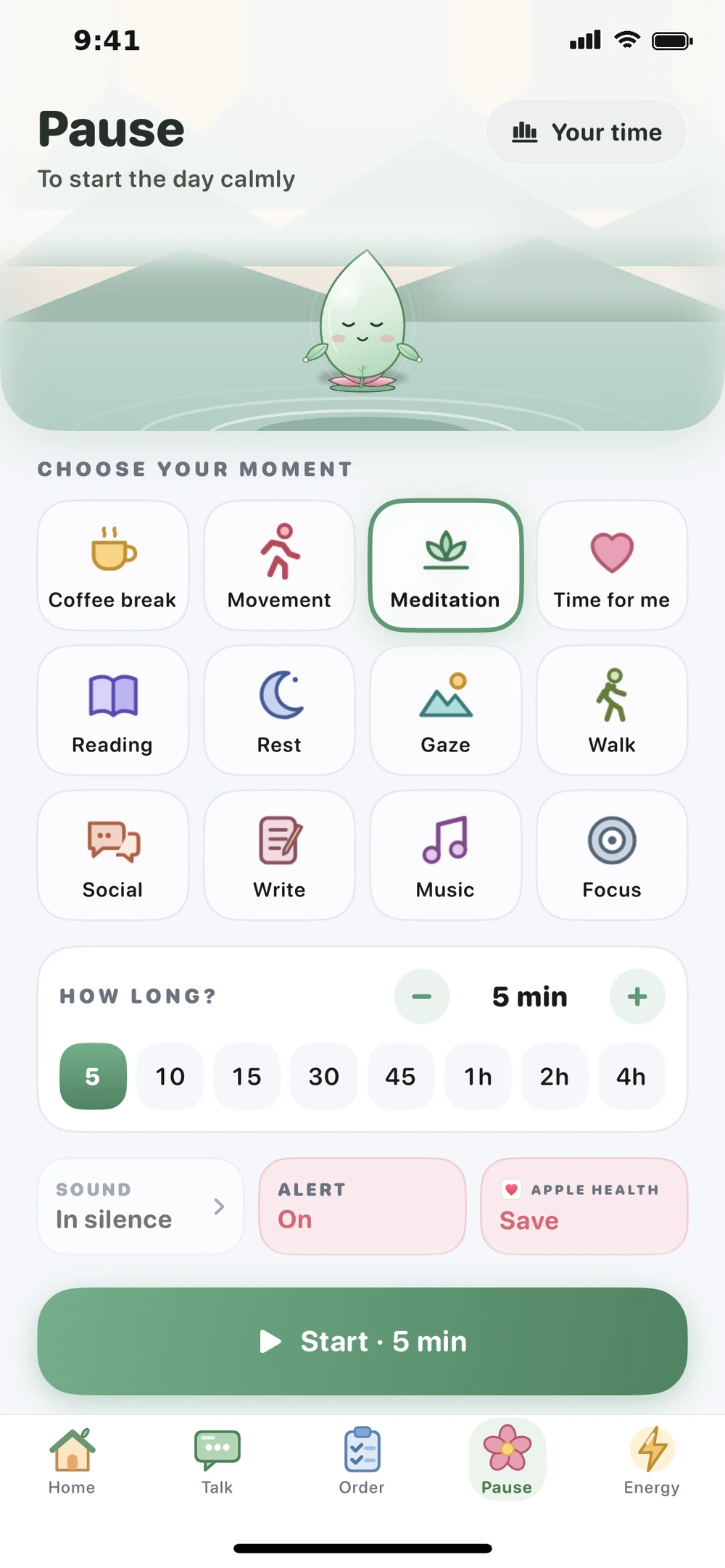
Senda's pauses are made for real days: a coffee, music, a walk, reading or rest, for the time you actually have, from 5 minutes to 4 hours. Senda keeps you company with gentle sound and lets you know when it ends.
- See your energy first, and pick the pause that fits.
- Empty your head in Order before you stop, so you can really switch off.
- Vent in Talk if the day still feels heavy.
Free plan, no card needed. 3-day free trial.
Frequently asked questions
What stretches help with stress?
Gentle neck side stretches, shoulder rolls, a chest opener, cat and cow, child's pose and legs up the wall, done slowly with long out-breaths, are easy stretches many people find calming.
How long should I stretch to relax?
Even five to ten minutes can help. Hold each stretch for about 20 to 30 seconds and breathe out slowly as you go into it.
Is it good to stretch before bed?
Gentle, slow stretching can be part of a calming bedtime routine. Avoid intense exercise right before sleep.
Can stretching replace exercise?
Not completely. Health guidelines recommend at least 150 minutes of moderate activity a week. Stretching is a good start and a useful break, but it works best alongside other movement such as walking.
Sources
Keep reading
Senda is a self-care and organization companion, not a medical service. This guide is informational and does not replace advice from a qualified professional.