
In short
- Children can help at home from a young age if the task fits their age and you show them how.
- Research has linked doing chores with better skills such as planning and self-control, although cause and effect are not clear.
- The goal is not a spotless house: it is a team where you are not the only one who sees what needs doing.
Why chores for kids are worth the effort
Getting a four-year-old to help often takes longer than doing it yourself. It still pays off. Children who help learn practical skills, feel useful and slowly start to notice what a home needs. Over time, that means fewer things only you can see.
A 2022 study from La Trobe University in Australia, summarised by the British Psychological Society, found that children who did more age-appropriate chores tended to have better executive functions, such as working memory and self-control. The researchers note that the direction of the effect is not clear, but chores are an easy, everyday way to practise these skills.
A list by age
Every child is different. Use this as a starting point, not a test.
| Age | Chores they can usually manage |
|---|---|
| 2–3 | Put toys in a box, put clothes in the laundry basket, help feed a pet with you, wipe up small spills |
| 4–5 | Set the table with unbreakable things, match socks, water plants, tidy their bedroom with help, carry their plate to the kitchen |
| 6–7 | Make their bed, sort laundry by colour, help put away shopping, pack their school bag, simple food prep like washing vegetables |
| 8–9 | Load or empty the dishwasher, fold and put away their clothes, take out the recycling, make a simple breakfast, sweep a room |
| 10–12 | Prepare a simple meal with supervision, clean the bathroom sink, change their bed sheets, help plan the week's meals, look after a younger sibling for short periods |
How to start without daily battles
- Pick one or two chores, not ten. Add more when these feel normal.
- Show, do together, then step back. Three times side by side before you expect them to do it alone.
- Keep the standard realistic. A wonky bed is still a made bed. Redoing their work tells them it does not count.
- Make it visible. A simple chart on the fridge with pictures for younger children.
- Attach chores to routines. "After dinner, you clear your plate" is easier than "remember to clear your plate".
- Talk about the team. "In this family we all look after our home" works better than "help mummy".
- Decide on rewards calmly. Some families link pocket money to extra jobs, not to everyday chores. Choose what fits your values.
Share the thinking too
As children grow, hand over not just the task but the noticing. A ten-year-old can be in charge of checking that there is bread for school lunches and adding it to the shopping list. That is a small piece of the mental load moving off your plate.
When they refuse or "forget"
Pushback is normal, especially at the start or when a new chore is added. A calm, boring response works better than a lecture:
- Use "when, then". "When the table is set, then we eat." The routine does the reminding, not you.
- Give a choice between two chores, not a choice about whether to help.
- Keep the consequence small and logical. If the laundry does not reach the basket, it does not get washed this time.
- Notice effort out loud. "You cleared your plate without being asked" teaches more than ten reminders.
A worked example
*This is an illustrative example, not a real user.* In Ana's house, the children are 5 and 9. The five-year-old sets the cutlery for dinner and puts her pyjamas under the pillow. The nine-year-old empties the dishwasher every morning and checks the fruit bowl on Sundays, telling Ana what to buy. It took three weeks of reminders. Now it happens most days without a word.
Common mistakes
- Starting with too many chores at once, then giving up after a week.
- Doing it for them because it is faster, every time.
- Using chores as punishment. It turns helping at home into something bad.
- Only giving chores to daughters. Boys and girls can do the same jobs at the same age.
- Keeping the system in your head. If the chart is not written down, you are still the one managing it.
 How Senda helps
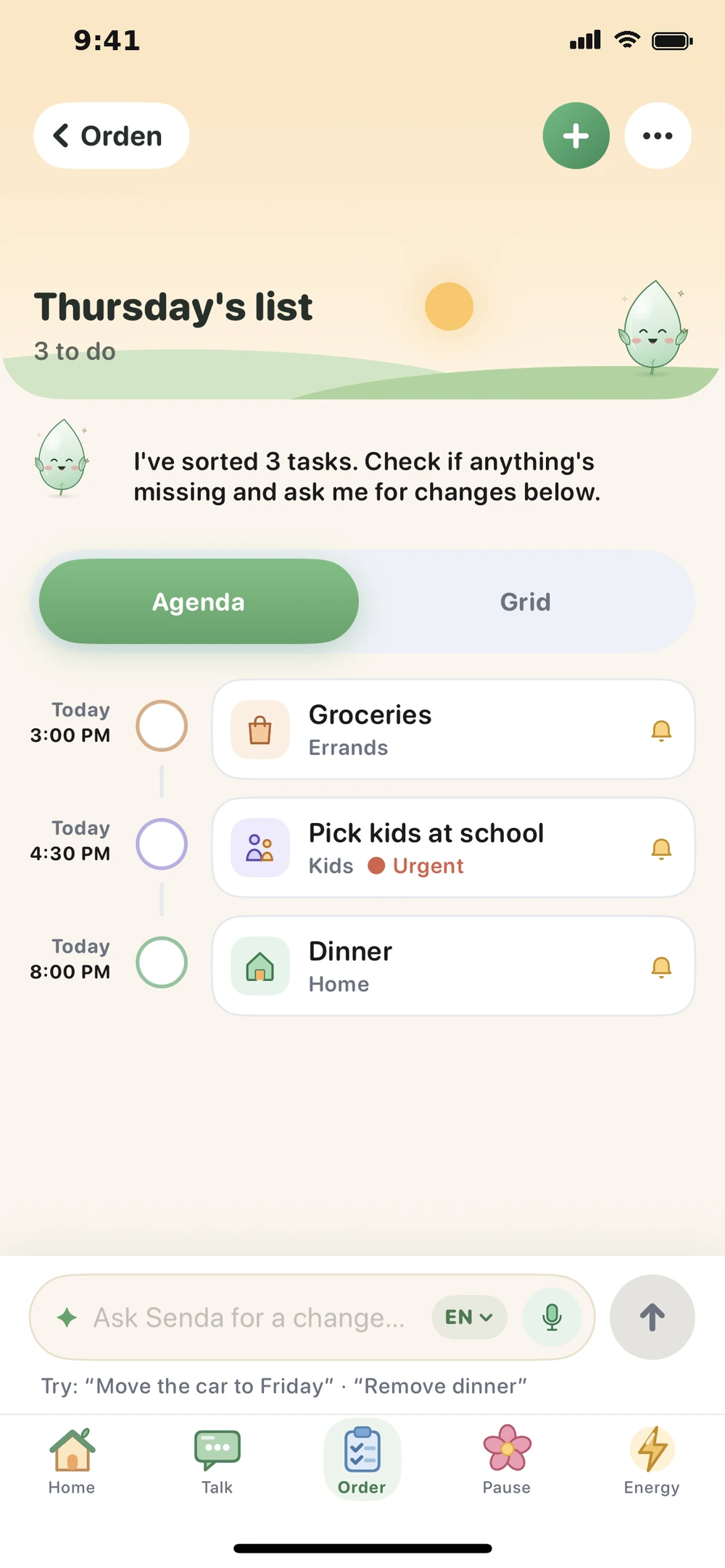
In Order, you dictate everything at once, however it comes out ("dentist Tuesday at 5, gift for Lucía, pay the gym") and Senda turns it into tasks with dates, categories and reminders. Change it just by saying so.
- Plan around your energy: Senda shows your level for the day.
- Vent in Talk when the list feels like too much.
- Protect a real break in your plan.
Free plan, no card needed. 3-day free trial.
Frequently asked questions
What chores can a 5-year-old do?
At around five, many children can set the table with unbreakable items, match socks, water plants, carry their plate to the kitchen and tidy their room with some help.
Should kids be paid for chores?
It is a family choice. Many families expect everyday chores without pay and offer pocket money for extra jobs. What matters most is being consistent.
How do I get my kids to do chores without nagging?
Start with one or two chores, show them how, link each chore to a routine like after dinner, use a visual chart and accept a good-enough result.
Are chores good for children's development?
Research has linked doing age-appropriate chores with better executive functions such as working memory and self-control, although it is not yet clear which causes which.
Sources
Keep reading




Senda is a self-care and organization companion, not a medical service. This guide is informational and does not replace advice from a qualified professional.