

In short
- Mental load is the invisible work of remembering, planning and anticipating everything a home and a family need.
- It weighs more on women: research links it to feeling overwhelmed and less satisfied with life and partnership.
- It gets lighter when you get it out of your head, decide what matters today and share the list instead of carrying it alone.
What is mental load?
Mental load is the work nobody sees: remembering the dentist appointment, noticing the milk is running out, knowing which form is due on Friday and planning dinner while you are still at work. It is not the tasks themselves, it is keeping all of them in mind.
Sociologist Allison Daminger describes it as cognitive labor with four steps: anticipating needs, identifying options, deciding and monitoring. The person who does those steps carries the load, even when someone else does the final task.
Why does it weigh more on women?
Studies keep finding the same pattern: in many couples, women do most of the anticipating and monitoring, even when both work full time. A 2019 study of mothers found that feeling solely responsible for the household was linked to feeling more overwhelmed and less satisfied with life and with their partner.
It is not about being "bad at delegating". When one person is the default manager, every delegated task still needs a reminder, a check and a backup plan.
7 signs you are carrying too much
- You wake up already going through a list.
- You are the only one who knows where things are or when they are due.
- You delegate, but you still have to remind and check.
- You feel tired even on days when you "didn't do much".
- Small things (a missing sock, a late email) make you snap.
- You can't switch off at night because your head keeps planning.
- You haven't had ten minutes for yourself in days.
7 ways to lighten your mental load
- Do a brain dump. Write or say everything that is in your head, without ordering it. Seeing it outside your head is already a relief.
- Sort it by when, not by importance. Today, this week, someday. Most things can wait more than you think.
- Pick one first step. A list of thirty items freezes you; one clear next step gets you moving.
- Share whole areas, not tasks. "You own school forms" removes the reminders; "Can you sign this?" does not.
- Write down the invisible work. Make a list of everything that keeps the house running. It makes the load visible and easier to talk about.
- Plan breaks like appointments. Five minutes of real pause counts. Waiting for "when everything is done" means never.
- Talk about it. Saying out loud what you carry, to a person or somewhere private, helps you see it clearly.
What mental load looks like in a normal week
Mental load is easiest to see in a real week. Here is what often sits in one person's head on a Monday morning, on top of her job:
| Area | What she is keeping track of |
|---|---|
| School | Trip form due Wednesday, PE kit, the book fair money |
| Health | Dentist reminder, repeat prescription, a vaccine booking |
| Food | What's for dinner all week, what's missing, who doesn't eat what |
| Family | Grandma's birthday on Saturday, a present, a card, who drives |
| Home | Boiler service, a parcel to return, the plumber's quote |
| Money | A school payment, a renewal, splitting a bill with a friend |
None of these tasks is big. The weight comes from holding all of them at once, remembering them at the right time and noticing what nobody has asked for yet.
Thinking, deciding, remembering: the three hidden jobs
Sociologist Allison Daminger describes this kind of work as cognitive labour, and breaks it into steps such as anticipating needs, identifying options, deciding and monitoring. In practice it looks like this:
- Anticipating: "The kids will need winter shoes soon."
- Researching: comparing sizes, prices and shops.
- Deciding: choosing the pair and the moment to buy.
- Monitoring: checking they arrived, fit and get used.
Often the "doing" (going to the shop) is shared, but the thinking around it is not. That is why many women say they do "everything" even when their partner helps.
Common mistakes when trying to lighten it
- Sharing tasks, not ownership. "Can you buy the shoes?" still leaves you to notice, research and remember. Hand over the whole area.
- Keeping the list in your head. As long as you are the only one who can see it, you will be the only one who carries it.
- Doing it alone at night. Planning after everyone is asleep makes the load invisible and steals your rest.
- Waiting for a perfect system. A shared note and a weekly check-in work better than an elaborate app nobody opens.
A 15-minute exercise to make it visible
Take a sheet of paper or a note on your phone and write, for 15 minutes, everything you are keeping track of this week. Then mark each line:
- D if only you know about it,
- S if someone else could own it,
- X if it can be dropped or postponed.
Share the "S" lines in a calm moment and agree who owns each area from now on. Use our free weekly planner template if it helps to see the week on one page.
You may also like: Brain dump: how to empty your head in 5 minutes (and turn it into a plan) · How to vent in a healthy way, and why putting it into words helps · Decision fatigue: why small choices wear you out (and how to make fewer)
When to look for more support
If the load comes with constant exhaustion, low mood that doesn't lift, or you feel you can't cope, talk to a GP or a mental health professional. Mental load is common, but you don't have to carry it alone.
 How Senda helps
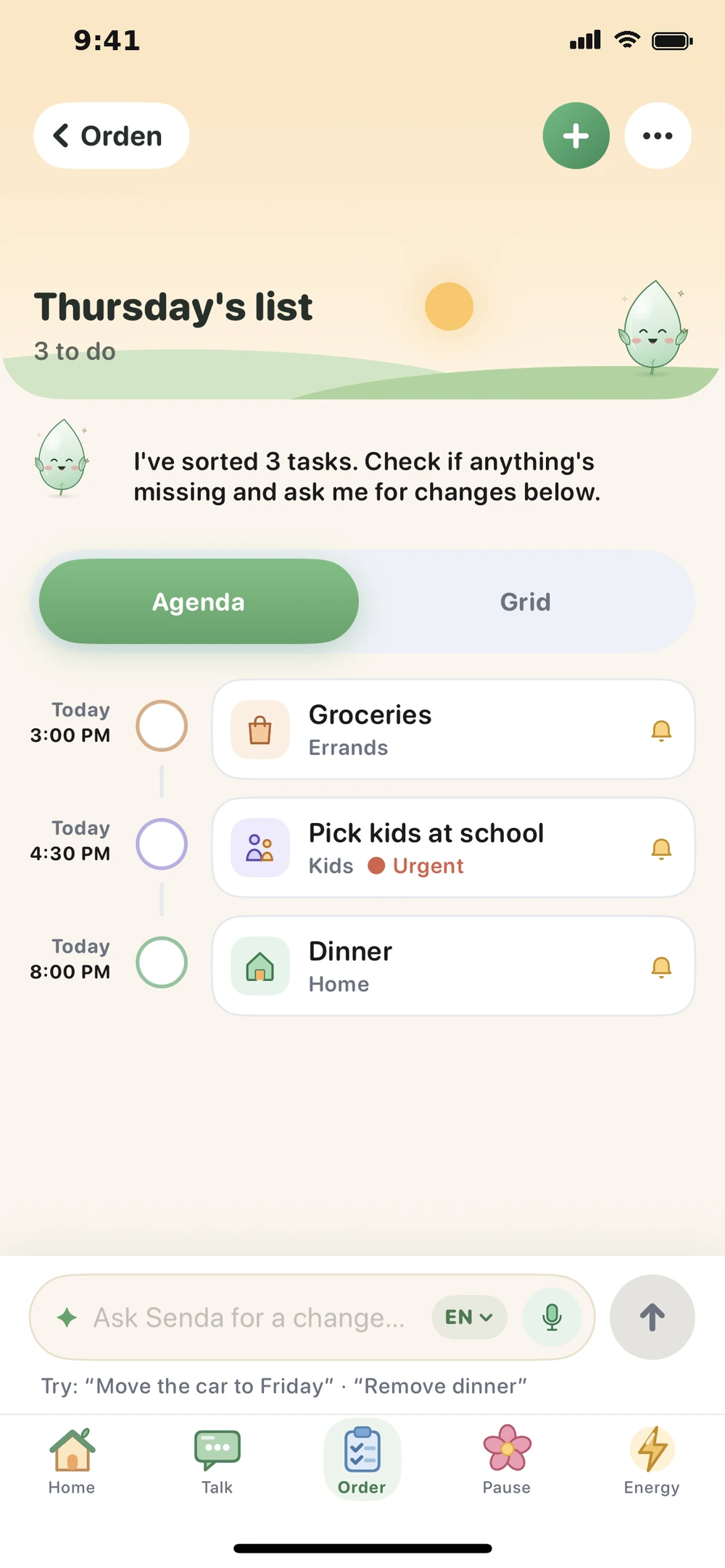
Senda was built for this. Dictate everything on your mind in one go ("dentist Tuesday at 5, buy a gift for Lucía, pay the gym") and Senda turns it into a plan with times, categories and reminders.
- Vent without judgment when it all feels like too much, in Talk.
- See your energy for the day and plan around it, not against it.
- Take a real break of 5 minutes or more when you need one.
Free plan, no card needed. 3-day free trial.
Frequently asked questions
What is the mental load?
Mental load is the invisible work of remembering, planning, anticipating and checking everything a household or family needs, on top of doing the tasks themselves.
What is an example of mental load?
Noticing the kids need new shoes, checking sizes, comparing options, buying them and remembering to return the ones that don't fit. Most of that work never shows.
How do I reduce my mental load?
Get it out of your head with a brain dump, sort it by when it is due, choose one first step and hand over whole areas of responsibility instead of single tasks.
Is mental load the same as burnout?
No. Mental load is the amount you carry; burnout is a state of exhaustion. Carrying too much for too long can contribute to burnout, so it is worth lightening early.
What are examples of mental load?
Remembering birthdays and buying presents, knowing when the children need new clothes, planning meals, booking appointments, keeping track of school forms and noticing what is running out at home are all examples of mental load.
How do I explain mental load to my partner?
Make it visible: write down everything you track in a week and show it in a calm moment. Explain that the tiring part is noticing, deciding and remembering, not just doing, and ask them to own whole areas.
Sources
Keep reading




Senda is a self-care and organization companion, not a medical service. This guide is informational and does not replace advice from a qualified professional.