

In short
- Fair doesn't always mean 50/50 in every task; it means both people feel the load is balanced.
- Include the invisible work: planning, remembering and checking.
- Split by ownership of whole areas and review the split every month.
Why chores cause so many arguments
Most couple arguments about chores are not about the dishes. They are about feeling unseen: one person carries the planning and the reminders, and the other doesn't notice. Research on household labor shows the thinking part of chores is often the least shared.
Sociologist Allison Daminger calls the planning part cognitive labor, and it is often the part nobody counts.
Step 1: list everything
Sit down together and write every job that keeps the house running, visible and invisible:
- Cooking, cleaning, laundry, shopping.
- Planning meals, noticing what's missing, booking repairs.
- School communication, appointments, gifts, family calendar.
- Pets, plants, bills, paperwork.
Step 2: estimate the weight
Mark each job as daily, weekly or occasional, and as light or heavy. A daily job that needs planning weighs more than a monthly one that doesn't.
Step 3: split by ownership
Each person owns whole areas: from noticing to finishing. "You own laundry" means you notice the basket, wash, dry and put away, without reminders.
Step 4: agree on standards
Decide together what "done" means for each area. Then let the owner do it their way.
Step 5: review every month
Life changes: new jobs, new schedules, a baby, an illness. Ten minutes a month to ask "does this still feel fair?" prevents resentment from building up.
An example split by ownership
| Area | Owner | Includes noticing and planning |
|---|---|---|
| Weekly food | Partner A | Menu, shopping list, the shop, cooking on weekdays |
| Laundry | Partner B | Washing, drying, putting away, school uniforms |
| Children's school | Partner A | Forms, payments, trips, the school app |
| Health | Partner B | Appointments, prescriptions, vaccinations |
| Home admin | Partner B | Bills, repairs, insurance renewals |
| Social and family | Each their own | Birthdays, gifts and calls for their own family |
Ownership means the owner notices when something is needed and handles it, without being reminded. That is what takes the mental load off the other person.
A worked example
*This is an illustrative example, not a real user.* Ana and Pablo list every household job and estimate the time each takes, including the thinking. Ana's column is twice as long. They move food and the school app to Pablo, and agree a 15-minute review on the first Sunday of the month. In the first review they adjust one thing: Pablo also takes the Friday shop, because he has a free afternoon.
Common mistakes
- Splitting 50/50 by task count. Some tasks are small and visible, others are constant and invisible. Weigh the time and the thinking.
- Keeping the right to redo. If the owner does it differently, let it be, unless it is a real problem.
- Never revisiting the deal. Jobs, children and schedules change; the split should too.
Why it matters for the relationship
Research that followed couples over eight years found that relationship satisfaction often drops after the arrival of a first child, a time when chores multiply. A fair split will not solve everything, but it removes one of the most common sources of daily friction and resentment, and leaves more energy for each other.
If your partner resists
Start from how you feel, not from blame: "I'm exhausted from keeping track of everything, and I'd like us to share it differently." Showing the full list often does more than any argument.
 How Senda helps
Senda makes the invisible list visible, starting with yours.
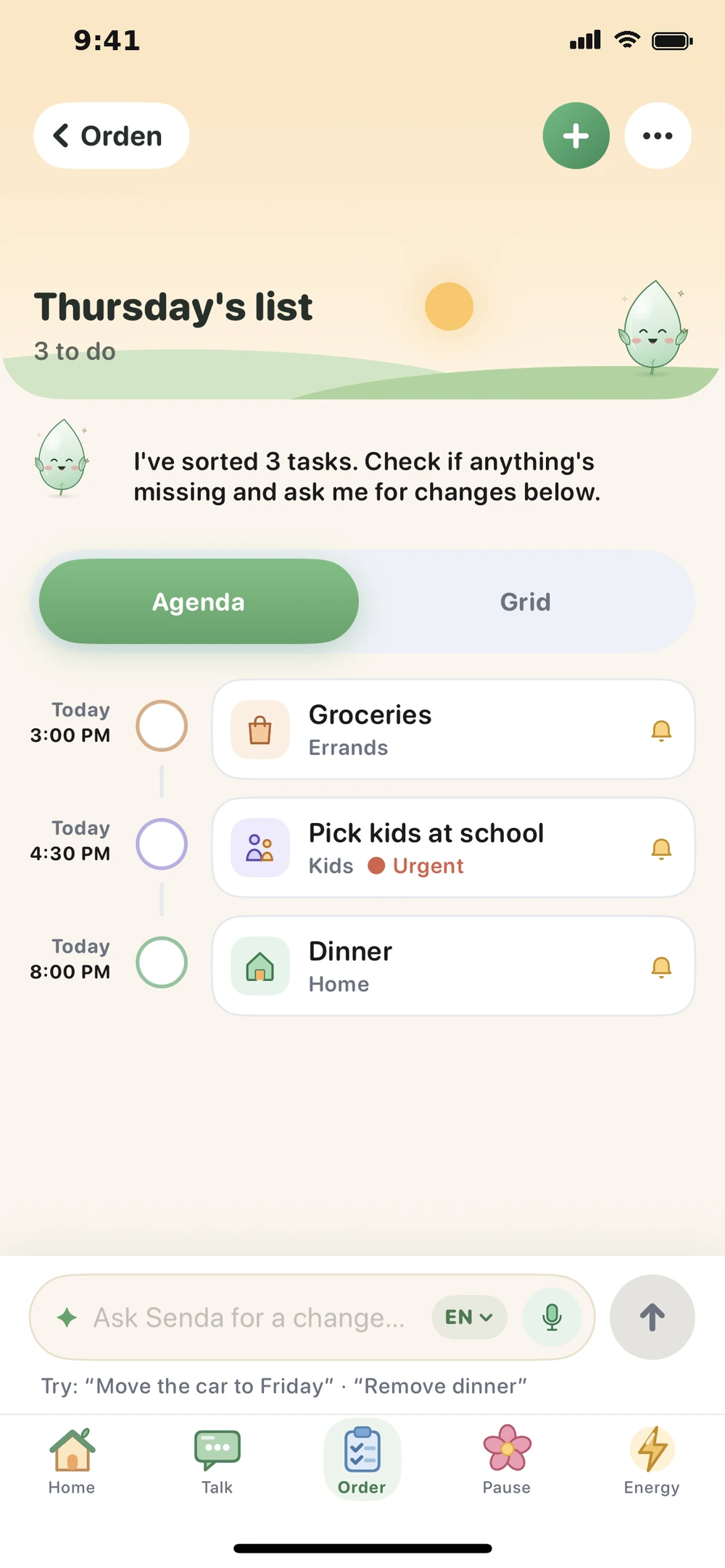
- In Order, dictate everything you keep track of and see it by category and day: a concrete list to bring to the conversation.
- Practice what you want to say in Talk before talking to your partner.
- Keep one pause a day for you, whatever the split.
Free plan, no card needed. 3-day free trial.
Frequently asked questions
How should couples split household chores?
List every job including invisible ones, estimate how often and how heavy each is, split whole areas of ownership and review the split once a month.
What is a fair division of housework?
A fair division is one where both partners feel the total load, including planning and remembering, is balanced, even if individual tasks are not split 50/50.
How do I ask my partner to help more at home?
Talk about how you feel rather than blaming, show the full list of tasks and propose that they take full ownership of specific areas.
What does it mean to own a chore?
Owning a chore means you notice when it needs doing, plan it and do it, without the other person having to remind you. It includes the thinking, not just the action.
How often should couples review the chore split?
A short monthly review works for many couples, plus a check-in whenever something big changes, such as a new job, a new baby or a new school year.
Sources
- Daminger, A. (2019). The Cognitive Dimension of Household Labor. American Sociological Review
- Doss, B. D., Rhoades, G. K., Stanley, S. M. & Markman, H. J. (2009). The effect of the transition to parenthood on relationship quality: an 8-year prospective study. Journal of Personality and Social Psychology
Keep reading




Senda is a self-care and organization companion, not a medical service. This guide is informational and does not replace advice from a qualified professional.