
In short
- A good weekly plan is short: three priorities, the fixed appointments and some empty space.
- Do it once a week, at the same time, in about 20 minutes. Sunday evening or Monday morning both work.
- Plan around your energy, not just your calendar, and leave a buffer: weeks never go as planned.
Why weekly planning helps
When everything lives in your head, every day starts with the same question: "what am I forgetting?". A weekly plan answers it once, so you can stop rehearsing the list at 3 a.m. It doesn't need an elaborate planner. It needs twenty minutes and a few clear decisions.
A predictable routine helps: the World Health Organization lists keeping a daily routine among its tips for managing stress.
The 20-minute method
1. Empty your head (5 minutes)
Write or dictate everything you need to do, remember or decide this week. Work, home, kids, appointments, the birthday present, the form for school. Don't sort it yet.
2. Look at the fixed things (3 minutes)
Open your calendar. Note what can't move: work hours, school runs, appointments, activities. This is the skeleton of your week.
3. Pick three priorities (4 minutes)
From your list, choose three things that would make this week feel like a good week. Not ten. Three. Put each one on a specific day.
4. Place the rest by day, roughly (5 minutes)
Spread the smaller tasks across the days where they fit. Heavy days get fewer tasks. Leave at least one evening with nothing planned.
5. Decide what can wait (3 minutes)
Some things on the list don't need to happen this week. Move them to "later" on purpose. That is a decision, not a failure.
Plan around your energy
A calendar shows hours; it doesn't show how tired you'll be. If Tuesday is long at work, don't put the big errand there. If you usually feel flat in the days before your period, keep those days lighter. Matching tasks to energy is one of the easiest ways to feel less behind.
Make it stick
- Same time every week. Attach it to something you already do, like Sunday tea or Monday coffee.
- Keep the plan visible. Phone, fridge, a shared note with your partner.
- Review on Wednesday. Two minutes: what moved, what can drop.
- Share it. If you live with someone, plan the week together for ten minutes. Half the mental load is being the only one who knows.
A sample weekly plan
This is what a realistic plan for a busy week can look like. Notice that it has few items per day, and lighter days where energy is usually lower:
| Day | Fixed | Top priority | Home and family | For you |
|---|---|---|---|---|
| Mon | Work 9–5 | Send the budget | Pasta night, PE kit | — |
| Tue | Work 9–5, swimming 6 pm | Call the bank | Soup night | 20-min walk |
| Wed | Work 9–3 | Finish the report | School trip payment | — |
| Thu | Work 9–5 | Prepare Friday's meeting | Partner cooks | Call a friend |
| Fri | Work 9–2 | Meeting | Takeaway night | Early night |
| Sat | Birthday party 4 pm | Buy present (Thu) | Shopping | Long walk |
| Sun | — | 20-min weekly plan | Batch-cook one meal | Free afternoon |
Common mistakes
- Planning every hour. A plan with no gaps breaks with the first delay. Leave buffers.
- Ignoring the fixed things. Write work hours, school runs and activities first; plan around them.
- Forgetting yourself. If rest and movement are not in the plan, they don't happen.
- Planning alone. Five minutes with your partner or older children turns your plan into a shared one.
- Starting over every week. Keep what worked from last week and change one thing.
Your weekly planning checklist
- ☐ Look at last week: what worked, what didn't.
- ☐ Write fixed commitments for each day.
- ☐ Choose one top priority per day.
- ☐ Plan meals and the shopping list.
- ☐ Assign owners for school, activities and home tasks.
- ☐ Block one thing for you on at least three days.
- ☐ Check birthdays, payments and deadlines for the next two weeks.
Print our free weekly planner template and keep it on the fridge, or use it as a model for your own.
A simple template
| Fixed | Priority | Smaller tasks | |
|---|---|---|---|
| Monday | Work 9–5, swimming 6 pm | Send the report | Buy milk, sign school form |
| Tuesday | Long day at work | — | Call the dentist |
| Wednesday | Work 9–3 | Doctor appointment | Quick review of the week |
| Thursday | Work 9–5 | — | Present for Lucía |
| Friday | Work 9–2 | Plan the weekend | Laundry |
 How Senda helps
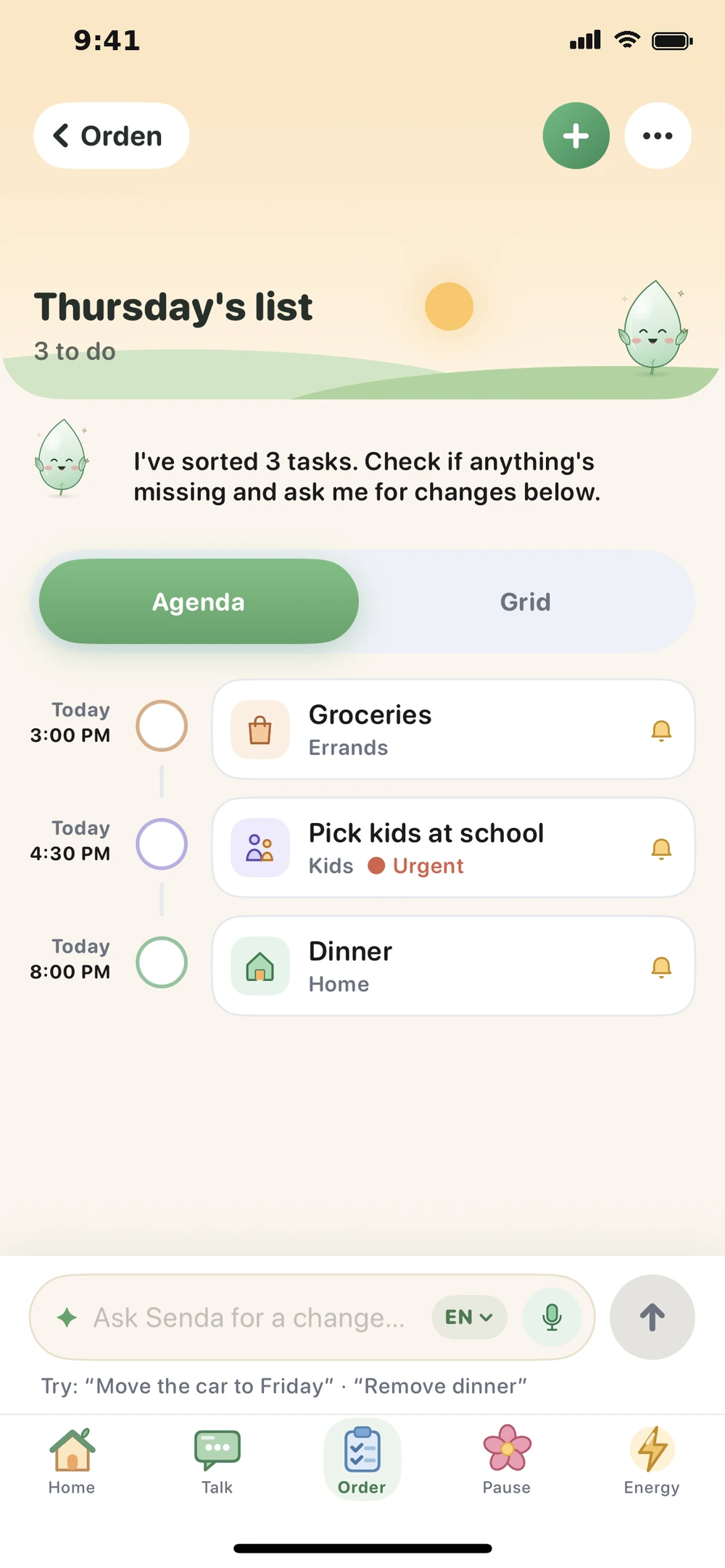
In Order, you dictate everything at once, however it comes out ("dentist Tuesday at 5, gift for Lucía, pay the gym") and Senda turns it into tasks with dates, categories and reminders. Change it just by saying so.
- Plan around your energy: Senda shows your level for the day.
- Vent in Talk when the list feels like too much.
- Protect a real break in your plan.
Free plan, no card needed. 3-day free trial.
Frequently asked questions
What is the best day to plan your week?
Whichever day you can protect. Many people plan on Sunday evening or Monday morning. What matters is doing it at the same time every week.
How long should weekly planning take?
About 20 minutes is enough: empty your head, check fixed appointments, choose three priorities and spread the rest across the week.
How many priorities should I have each week?
Three is a good number. More than that and nothing feels like a priority anymore.
What is the best day to plan your week?
Many people prefer Sunday afternoon or evening, but any calm moment works. What matters is doing it at the same time every week so it becomes a habit.
What should a weekly plan include?
Fixed commitments, one priority per day, meals and shopping, who is responsible for what, upcoming deadlines and at least a few moments for yourself.
Sources
Keep reading



Senda is a self-care and organization companion, not a medical service. This guide is informational and does not replace advice from a qualified professional.