

In short
- Mom guilt is the sense of never doing enough: at work, at home, for your kids and for yourself.
- Some guilt points to something you care about; most of it comes from impossible standards.
- Naming it, talking about it and asking "what would I tell a friend?" helps quiet it.
What is mom guilt?
Mom guilt is that voice that says you should be doing more, better or differently: working less, playing more, cooking healthier, being more patient. It often shows up exactly when you do something for yourself.
A 2019 study by Ciciolla and Luthar found that mothers who felt solely responsible for the household felt more overwhelmed and less satisfied.
Where it comes from
- Impossible standards. Social media and advice make it look as if other mothers do everything.
- Invisible work. When you carry the planning, every forgotten detail feels like your fault.
- Competing roles. Work, partner, children, parents and yourself rarely fit in one day.
Useful guilt vs. unfair guilt
Useful guilt points to something you can change and care about: "I want more unhurried time with them". Unfair guilt asks for the impossible: "I should never get tired". The first is worth listening to; the second is worth questioning.
5 gentle ways to quiet mom guilt
- Name it out loud. "This is guilt, not a fact." Saying it creates distance.
- Ask the friend question. What would you tell a friend in your exact situation?
- Swap "should" for "want". "I should play more" becomes "I want 20 minutes of play after dinner". Smaller and doable.
- Look at the whole week. One rushed morning doesn't define you. Count the good moments too.
- Talk about it. Guilt grows in silence and shrinks when shared, with your partner, a friend or somewhere private.
Common guilt thoughts, and kinder answers
| Guilt thought | A fairer way to see it |
|---|---|
| "I shouted, I'm a terrible mother." | "I lost my temper. I can repair it with a hug and an apology." |
| "They're in nursery all day because of me." | "They are cared for, and my work supports our family." |
| "I should be enjoying every moment." | "Nobody enjoys every moment. Loving them and being tired can go together." |
| "Other mothers do more." | "I see their best moments, not their whole day." |
| "I took time for myself." | "Rest makes me a calmer parent." |
A worked example
*This is an illustrative example, not a real user.* Every Thursday, Raquel feels guilty for going to her evening yoga class. She notices the thought, "I'm abandoning them", and checks it against the facts: the children are with their father, they are happy and she comes back calmer. She keeps the class and, instead of rushing home, tells the children about it at breakfast. The guilt does not vanish, but it gets quieter.
Common mistakes
- Trying to make the guilt go away by doing more. It usually just moves to the next thing.
- Hiding your own needs until you are exhausted. Children benefit from a parent who looks after herself.
- Using social media as the yardstick. Mute accounts that leave you feeling smaller.
When guilt becomes heavy
Occasional guilt is part of caring deeply. If guilt is constant, comes with low mood, anxiety or feeling worthless, or stops you from sleeping or enjoying your children, talk to your doctor or health visitor. Persistent guilt and low self-worth can be signs of postnatal depression or anxiety, which can appear months or even a year after birth and can be treated.
Read next: Parental burnout: the signs, the causes and what actually helps
When guilt is a sign of something more
If guilt comes with constant sadness, anxiety or thoughts that you are a bad mother that won't go away, talk to a professional. Postpartum and parenting can bring real mood changes, and help is available.
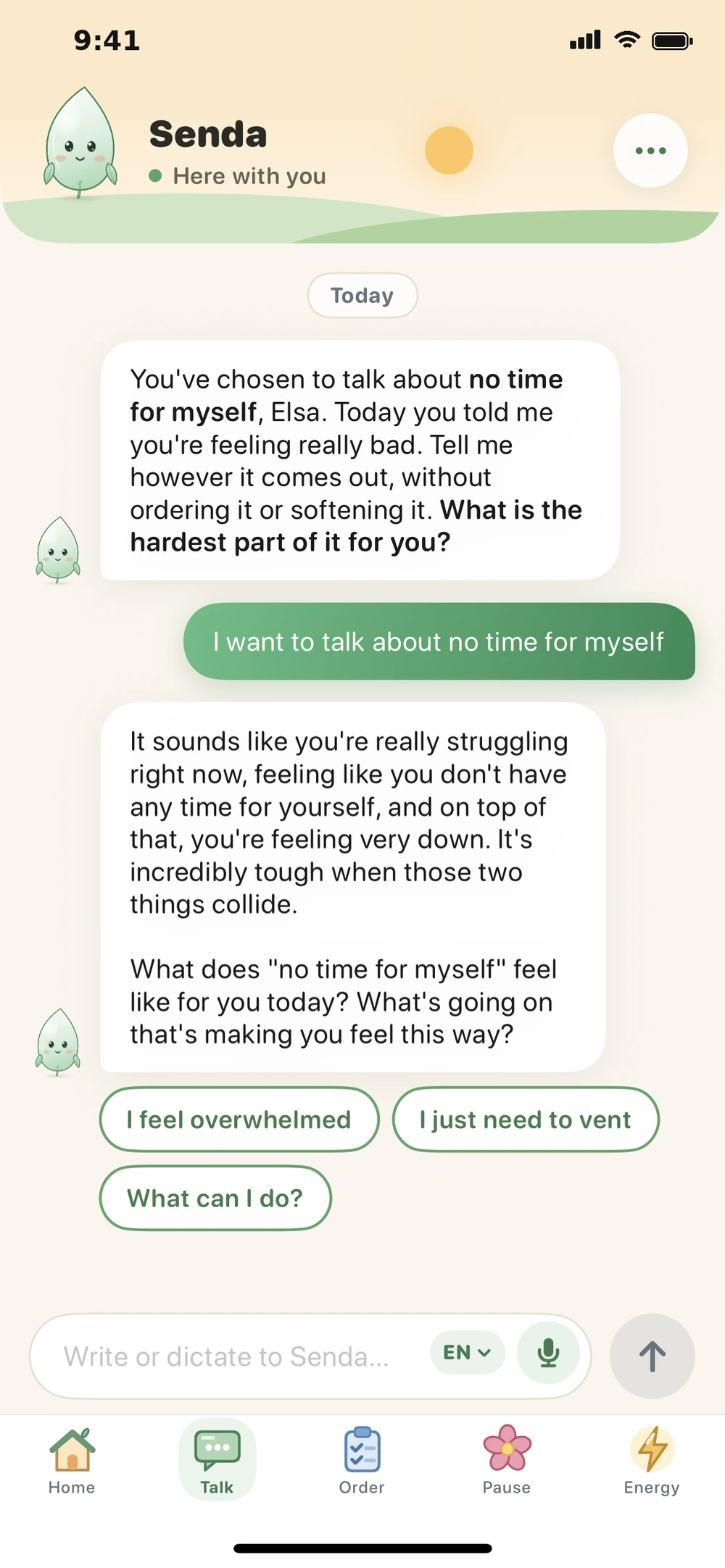
 How Senda helps
Senda gives you a private place to say what you feel, without being judged.
- In Talk, Senda listens first and asks before it advises. Say "I feel like I'm failing at everything" and start from there.
- In Order, see what you actually did today: crossed-off tasks count.
- A real pause for you is part of the plan, not a reward.
Free plan, no card needed. 3-day free trial.
Frequently asked questions
What is mom guilt?
Mom guilt is the persistent feeling that you are not doing enough or not doing it right as a mother, often triggered by work, rest or time for yourself.
Is mom guilt normal?
It is very common. Many mothers feel it, especially when they carry most of the planning at home or balance work and family.
How do I stop feeling guilty as a working mom?
Separate useful guilt (something you can change) from unfair guilt (impossible standards), turn "should" into a small concrete want, and talk about it instead of carrying it alone.
How do I deal with mom guilt?
Notice the guilt thought, check it against the facts, repair what needs repairing, lower impossible standards and make room for your own needs without apologising.
Why do I feel guilty taking time for myself?
Many mothers learn that a good mother puts herself last. In reality, time to rest and recharge helps you be more patient and present with your children.
Sources
Keep reading




Senda is a self-care and organization companion, not a medical service. This guide is informational and does not replace advice from a qualified professional.