

In short
- Feeling overwhelmed usually means too many open loops at once, not that you are failing.
- Start small: one hour to calm your body and get everything out of your head, then decide only today.
- If the feeling lasts weeks or comes with low mood or poor sleep, talk to your doctor.
What "overwhelmed" really means
Overwhelm is the feeling that what you have to do is bigger than what you can hold. It is rarely one big problem. It is the school form, the email you did not answer, the dinner, the appointment, the birthday and the work deadline, all asking for attention at the same moment.
The World Health Organization describes stress as a natural reaction to challenges or threats in our lives. A little of it helps you act. When the demands keep piling up and there is no moment to close any of them, stress turns into that frozen, everything-at-once feeling. The NHS lists feeling overwhelmed among the common signs of stress, together with irritability, racing thoughts and trouble sleeping.
Why it hits women who run a home so often
Many women carry two jobs at once: the paid one, and the job of noticing, remembering and deciding everything at home. That second job has no hours and no finish line. Each task is small, but you hold all of them in your head, so the load never goes down. When something extra arrives (a sick child, a work emergency, a family visit), there is no spare room left.
The next hour: calm first, then empty your head
You cannot plan well while your body is in alarm mode. So the first hour is not about doing more. It is about getting enough calm to think.
- Stop for two minutes. Sit down, put both feet on the floor and breathe out slowly, longer than you breathe in. Repeat ten times.
- Drink a glass of water and eat something if you have not.
- Write everything down. Every task, worry and loose end, in any order, for ten minutes. Do not organise yet. Getting it out of your head is the point.
- Circle only what has a deadline today or tomorrow. Usually it is far fewer things than it felt like.
- Pick one small thing and finish it. Closing one loop tells your brain that things can move.
The rest of today: decide only today
Overwhelm feeds on the future: everything you will have to do next week, next month, this year. For today, use a short list:
| Keep for today | Move or drop |
|---|---|
| Things with a real deadline today | "Should do" tasks with no date |
| Basic care: food, sleep, the children | Perfect versions of anything |
| One thing that would make tomorrow lighter | Favours you agreed to out of guilt |
| One small break, even ten minutes | Replying to every message right now |
Then send one message asking for help or moving something. "I can't do Thursday, can we make it next week?" is a complete sentence.
This week: lower the load, not just the stress
Calming down helps, but if the load stays the same the feeling will come back. During the week:
- Hand over whole areas, not single tasks. "You are in charge of the school lunches" removes a whole category from your head.
- Plan once, not all day. Fifteen minutes on Sunday to see the week saves dozens of small decisions. Our weekly planner template can help.
- Lower the standard on purpose. Frozen vegetables, a simpler birthday, a quicker clean. Good enough is a decision, not a failure.
- Protect one real break a day. Not scrolling: a walk, a shower, five minutes with a cup of tea and nothing else.
A worked example
*This is an illustrative example, not a real user.* Marta, 38, two children, full-time job. On Monday at 9 pm she feels she cannot breathe. She writes for ten minutes and gets 31 items. Only five have a deadline in the next 48 hours. She does the school payment in two minutes, texts her sister to take her mother to the doctor on Wednesday, moves a work call and decides that dinner tomorrow is pasta. Thirty-one items became four for tomorrow. The rest went into a dated list for later in the week.
Common mistakes
- Trying to fix it with a big productivity system in the middle of the crisis. First calm, then empty, then plan.
- Doing everything at night when the house is quiet. It steals your sleep, and tired people feel more overwhelmed.
- Keeping the list in your head so nobody else can help.
- Waiting until it passes. If the load does not change, the feeling does not either.
You may also like: Decision fatigue: why small choices wear you out (and how to make fewer)
When to get help
Feeling overwhelmed now and then is part of a busy life. Talk to your doctor if it lasts for weeks, if you cannot sleep, if you feel hopeless or if you are struggling to get through the day. The NHS also suggests talking to someone you trust: saying it out loud often makes the load feel lighter. If you ever feel in danger, call your local emergency number.
 How Senda helps
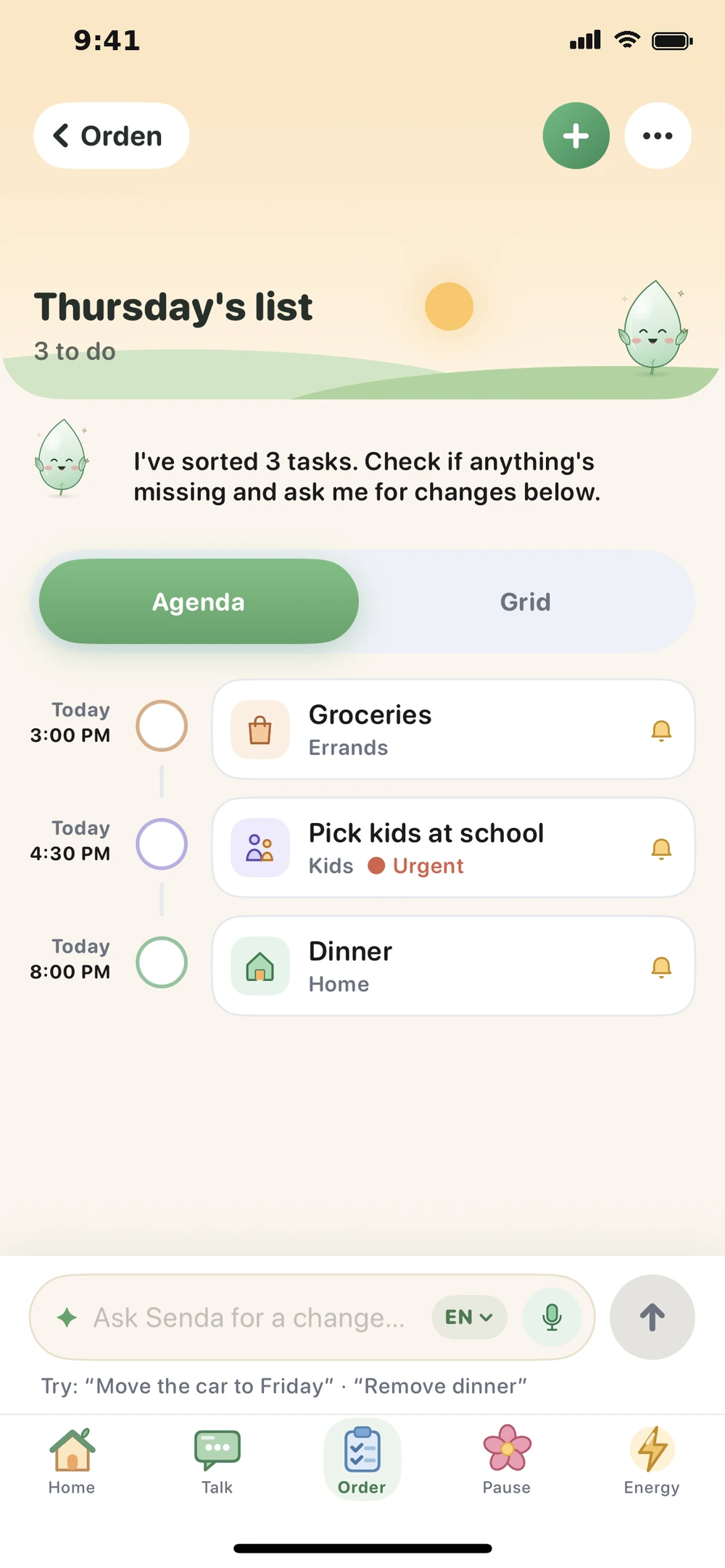
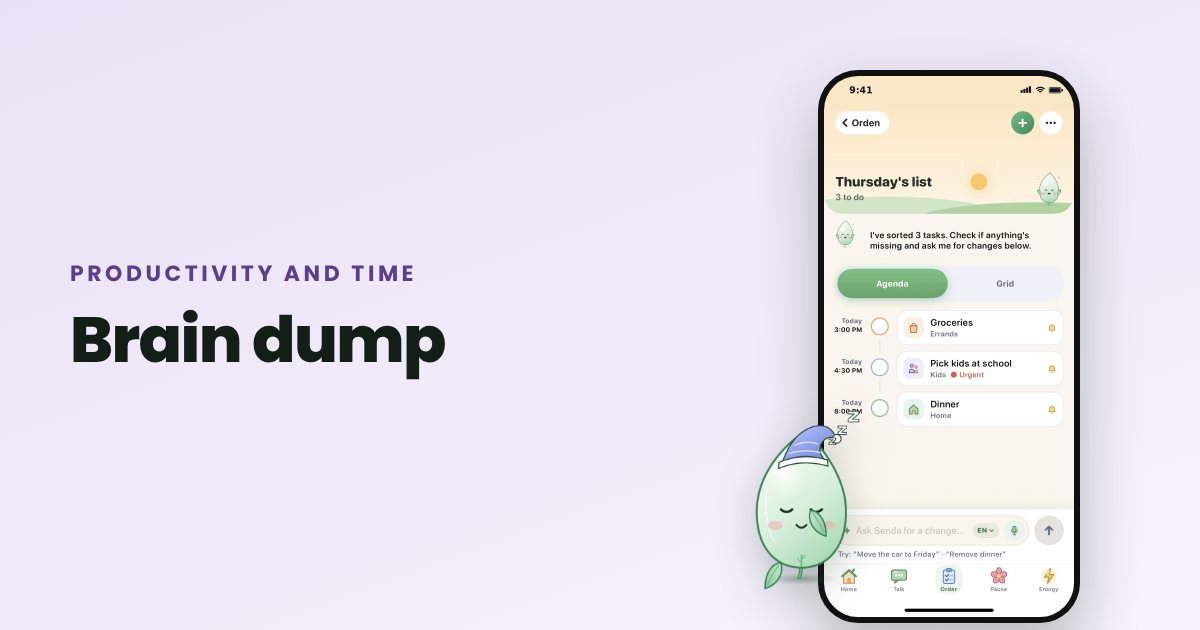
In Order, you dictate everything at once, however it comes out ("dentist Tuesday at 5, gift for Lucía, pay the gym") and Senda turns it into tasks with dates, categories and reminders. Change it just by saying so.
- Plan around your energy: Senda shows your level for the day.
- Vent in Talk when the list feels like too much.
- Protect a real break in your plan.
Free plan, no card needed. 3-day free trial.
Frequently asked questions
What should I do when I feel overwhelmed?
Stop for a few minutes and breathe out slowly, write down everything on your mind, keep only what has a deadline today or tomorrow, finish one small thing and ask for help with one task.
Why do I feel overwhelmed all the time?
Often because too many tasks and decisions stay open at once, especially when you carry most of the planning at home and at work. Long-lasting overwhelm can also be a sign of stress or low mood worth discussing with a doctor.
Is feeling overwhelmed a sign of burnout?
It can be one sign. Burnout usually also includes deep exhaustion and feeling detached or less effective. If you recognise these together and they last, talk to a professional.
How do I explain to my partner that I feel overwhelmed?
Choose a calm moment, show your written list and ask them to take over whole areas, not single tasks. Seeing the load on paper usually helps more than describing it.
Sources
Keep reading


Senda is a self-care and organization companion, not a medical service. This guide is informational and does not replace advice from a qualified professional.