

In short
- Choose a calm moment, not the middle of an argument or a messy kitchen.
- Talk about how you feel and what you carry, with concrete examples, not about who is to blame.
- End with a small, concrete change you both agree to try.
Why this conversation is hard
Mental load is invisible, so your partner may honestly not see it. When you finally bring it up, often after weeks of holding it in, it can come out as frustration and land as criticism. A little preparation changes how it goes.
A 2019 study by Ciciolla and Luthar linked feeling solely responsible for the household with lower satisfaction with the partnership.
Pick the right moment
Not in the middle of a fight, not at 11 p.m., not while one of you is cooking. Ask for a moment: "Can we talk this weekend about how we share things at home? It matters to me."
Prepare two or three examples
Abstract complaints ("you never help") lead to defensiveness. Concrete examples help: "This week I booked the dentist, bought the gift, replied to school and planned dinners. I felt like I was managing everything."
Words that help
- "I feel..." instead of "You always..."
- "I need us to..." instead of "You should..."
- "Can we try..." instead of "From now on you..."
Words that make it harder
- Absolutes like "always" and "never".
- Comparing with other couples.
- Bringing up every past grievance at once.
Listen too
Your partner may feel criticized or may not have realized. Ask what they see and what is hard for them. The goal is a team, not a verdict.
Turn it into a plan
End with one or two concrete changes: "You'll own school communication this term" or "We'll do a 15-minute plan on Sundays". Agree to check in after a month.
A short script you can adapt
| Step | What you could say |
|---|---|
| Open calmly | "Can we talk for 15 minutes on Sunday about how we run the house? I'm not angry, I'm tired." |
| Show, don't list complaints | "I wrote down everything I kept track of this week. Can you look at it with me?" |
| Name the thinking work | "It's not only doing things. It's noticing, planning and remembering." |
| Ask for ownership | "Could you take over the school and the shopping completely, including remembering?" |
| Agree a review | "Let's check in on the first Sunday of next month." |
A worked example
*This is an illustrative example, not a real user.* Lola has tried to talk about the mental load three times, and each time it ended in an argument. This time she chooses a quiet Sunday morning, brings a written list and starts with "I need your help" instead of "you never". Her partner is surprised by how much is on the list. They agree he takes over the children's activities, and they put a review in the calendar.
Common mistakes
- Starting the talk in the middle of a fight. Choose a calm moment instead.
- Using "always" and "never". They make the other person defend themselves instead of listening.
- Ending without a concrete change. Agree at least one area that moves today.
After the conversation
Change takes practice. In the first weeks, your partner may forget or do things differently. Try not to take the area back. A short, friendly reminder the first time and the agreed monthly review are usually enough. If the same conversation keeps going in circles after a few months, a couples counsellor can help you both find a way through.
If it keeps going in circles
If the same conversation keeps turning into conflict, a couples counselor can help you both be heard.
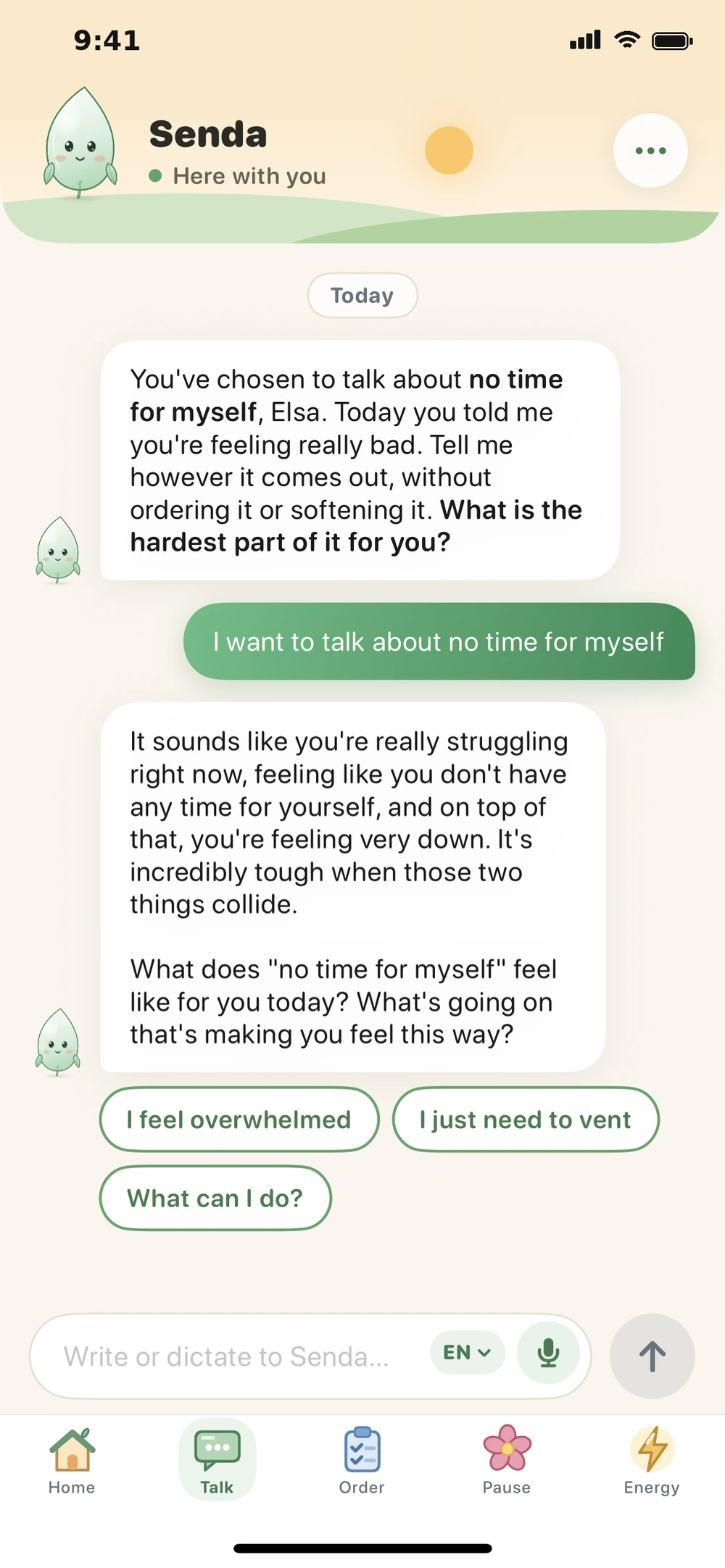
 How Senda helps
Before a hard conversation, it helps to put your thoughts in order.
- In Talk, say how you feel and ask Senda to help you find the words: "help me explain mental load to my partner without blaming".
- In Order, your own task list gives you concrete examples of what you carry.
- After the talk, take a pause just for you.
Free plan, no card needed. 3-day free trial.
Frequently asked questions
How do I explain mental load to my partner?
Choose a calm moment, give two or three concrete examples of the planning work you did that week and explain how it makes you feel, then propose one specific change.
How do I bring up mental load without starting a fight?
Use "I feel" and "I need" instead of "you always", avoid absolutes, listen to your partner's view and focus on a shared plan rather than blame.
What if my partner doesn't see the mental load?
Show the full list of invisible tasks for a week. Seeing it written down often helps more than explaining in general terms.
What if my partner gets defensive about the mental load?
Pause and come back to it at a calmer moment, start with how you feel and what you need, show a written list rather than complaints, and ask for one concrete change at a time.
How do I make the change last?
Agree whole areas of ownership, write them down and put a short monthly review in the calendar so you can adjust before resentment builds up again.
Sources
Keep reading




Senda is a self-care and organization companion, not a medical service. This guide is informational and does not replace advice from a qualified professional.