

In short
- When everything feels urgent, your brain freezes. The fix is a short daily ritual, not a perfect system.
- Sort by fixed time first (appointments, pick-ups), then by what moves your week forward, then by energy.
- Choose three things for today. Everything else goes to "this week" or "someday".
Why everything feels urgent
When your to-do list lives in your head, every item shouts at the same volume. The school form, the work report and the birthday gift all feel like "now". That is not a lack of discipline; it is what happens when there is no outside place to sort things.
Keeping a simple daily routine is one of the ways the World Health Organization suggests to cope with stress, and deciding your priorities is the heart of it.
The 10-minute daily plan
Minute 1–3: empty your head
Write or say everything you need to do, big and small. Don't order it yet.
Minute 4–5: mark what has a fixed time
Appointments, pick-ups, meetings, deadlines today. These go first because they won't move.
Minute 6–8: choose your three
From what is left, choose three things that would make today feel done. One can be small. If one of them is for you (a walk, a call with a friend), even better.
Minute 9–10: park the rest
Put everything else into "this week" or "someday". Parking is not failing; it is deciding.
Three questions that sort any task
- Does it have a time? If yes, it goes in the agenda, not the list.
- What happens if it waits a week? If nothing, it can wait.
- Can someone else own it? Not "help with it": own it, from start to finish.
Match tasks to your energy
Do focused work when your energy is higher and leave admin, calls or tidying for lower moments. Many women notice their energy changes across the week and across their cycle; planning with it instead of against it makes the same day feel lighter.
A simple priority grid
When the list is long, sort each task into one of four boxes. It takes five minutes and usually shows that far fewer things are truly urgent.
| Important | Not important | |
|---|---|---|
| Urgent | Do today (school form due tomorrow, a bill) | Do quickly or hand over (reply to the group chat) |
| Not urgent | Plan a time this week (book the check-up) | Drop or postpone (reorganise the photos) |
Most stress comes from the top-right box: things that feel urgent because someone is waiting, but do not really matter. Those are the first to hand over or answer in one line.
A worked example
*This is an illustrative example, not a real user.* On Tuesday morning Inés has 14 things on her list. She gives herself ten minutes: three go to "today" (a work deadline, the pharmacy, the swimming kit), four get a day this week, five are handed over or answered in one line, and two are dropped. She writes the three "today" tasks on a sticky note and hides the rest of the list until Thursday.
Common mistakes
- Starting with the easiest tasks because ticking things off feels good, and leaving the important one for the evening.
- Planning more than you can do. Three important things a day is a realistic number for most busy days.
- Treating every message as urgent. Most can wait a few hours.
- Never reviewing. A list that is not checked once a week grows until it feels impossible.
Use our free to-do list template if you want a one-page way to sort the week.
A 3-minute end-of-day reset
Before you close the laptop or go to bed, look at the list once more. Move anything unfinished to a specific day, cross out what no longer matters and choose tomorrow's three important things. Writing them down tonight means you start tomorrow with a plan instead of a cloud of worries, and your head has less to hold while you sleep.
You may also like: Decision fatigue: why small choices wear you out (and how to make fewer)
When the plan breaks
Some days the plan falls apart by 10 a.m. That's normal. Go back to your three, keep the one that matters most and move the rest without guilt.
 How Senda helps
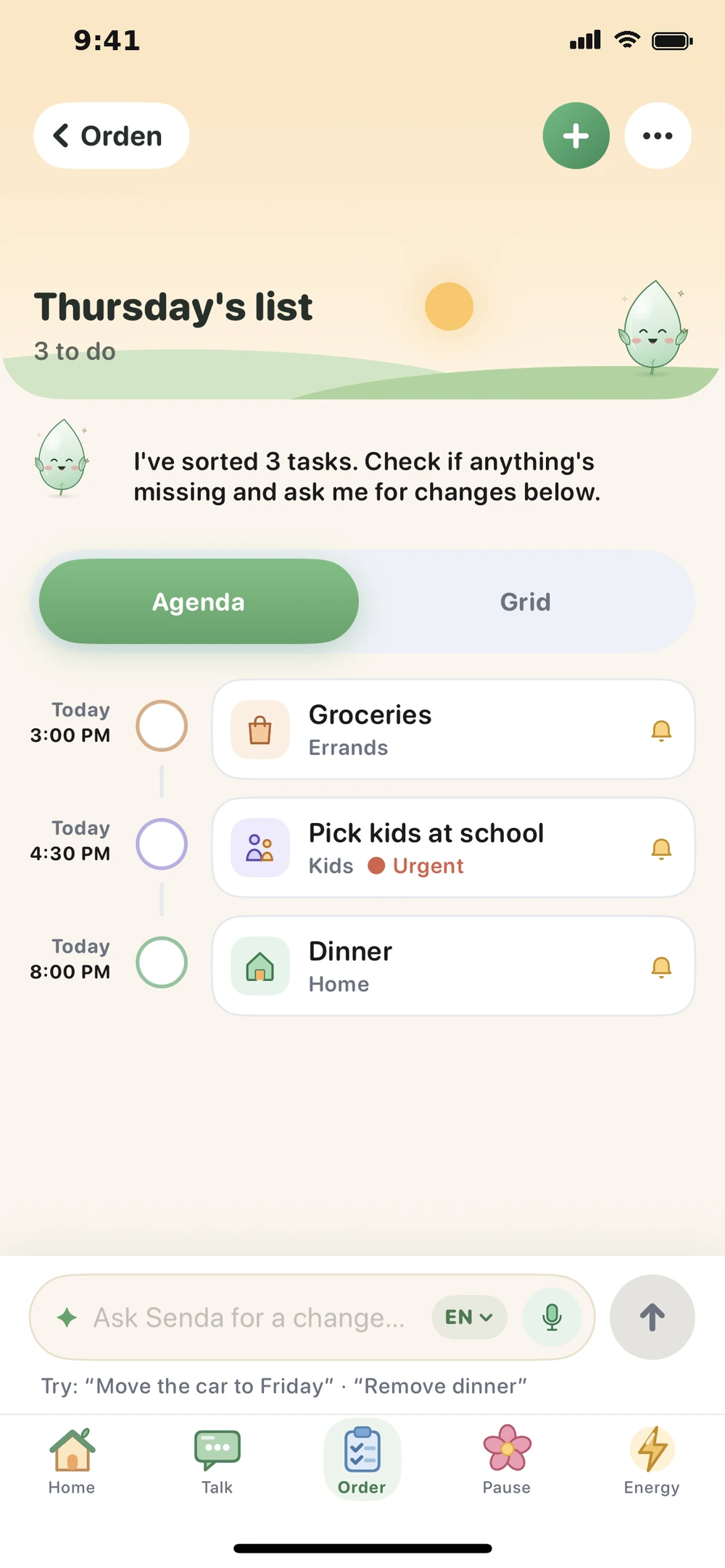
In Senda's Order tab you say everything at once ("call the plumber, pick up the kids at 4:30, finish the report by Friday") and Senda sorts it into today, this week and later, with times and reminders.
- Switch between Agenda and Grid to see your day or your priorities.
- Ask for changes in plain words: "move the plumber to Monday".
- See your energy for today on the home screen and plan around it.
Free plan, no card needed. 3-day free trial.
Frequently asked questions
How do I prioritize when everything is urgent?
Empty your head onto a list, put anything with a fixed time in your agenda, choose three things that would make today feel done and park the rest for later in the week.
What is the best method to prioritize tasks?
The best method is the one you will use daily. A short ritual of brain dump, fixed times first and three priorities works for most busy people.
How many tasks should I plan per day?
Plan around your fixed appointments and choose about three priorities. More than that usually leads to a list you never finish.
What is the Eisenhower matrix?
It is a simple grid that sorts tasks by urgency and importance into four boxes: do now, plan, hand over and drop. It helps you see which tasks really need your attention today.
Why do I always do the easy tasks first?
Easy tasks give a quick feeling of progress. It is normal, but it can leave the important task for when you are tired. Try doing one important task first, then the easy ones.
Sources
Keep reading



Senda is a self-care and organization companion, not a medical service. This guide is informational and does not replace advice from a qualified professional.