
In short
- Procrastination is often a way to escape a bad feeling, not laziness.
- Research links it to short-term mood repair: you put the task off to feel better now.
- The fix is to make starting smaller and kinder: two minutes, one step, one clear next action.
Procrastination is not laziness
If you are reading this, you probably have a list of things you keep pushing to tomorrow, and a voice that says you are lazy or disorganised. That voice is usually wrong. Many people procrastinate most when they care a lot and have too much on.
Psychologists Fuschia Sirois and Timothy Pychyl describe procrastination as a priority of short-term mood regulation: we put off a task because it makes us feel uneasy, bored, anxious or overwhelmed, and avoiding it gives quick relief. The relief is real, but short. The task is still there tomorrow, now with guilt on top.
Why it gets worse when you are overwhelmed
When everything feels urgent, every task carries the weight of all the others. Opening one email reminds you of ten more. Starting the tax form makes you think of the dentist, the school trip and the fridge. Your brain does what it is built to do: it looks for something that feels better right now. Scrolling, tidying a drawer, answering easy messages.
Common triggers are:
- The task is vague. "Sort out the insurance" has no first step.
- The task is big. It looks like hours, so there is never a good moment.
- The task carries a feeling. Fear of a call, shame about a delay, worry about the result.
- You are tired. Starting needs energy, and evenings rarely have it.
How to start (without forcing yourself)
- Name the feeling. "I'm avoiding this because I'm scared they'll say no." Naming it lowers its grip.
- Turn the task into a next action. Not "insurance", but "find last year's policy number in my email".
- Use a two-minute start. Promise yourself only two minutes. Often you keep going, and if not, you have still moved.
- Lower the bar for the first version. A messy draft beats a perfect plan that never starts.
- Pick your best energy time. Do the heavy task when you usually feel clearest, often the morning.
- Remove one obstacle. Open the document, put the form on the table, save the phone number. Make starting easy for tomorrow-you.
- Pair it with something kind. A coffee you like, music, a friend on the phone while you fill in the form.
Turning a vague task into steps
| Vague task | First next action | Time |
|---|---|---|
| Sort out the insurance | Find last year's policy number | 3 min |
| Plan the birthday party | Text two parents to ask about Saturday | 2 min |
| Deal with the bank | Book a call slot online | 5 min |
| Clean out the wardrobe | Fill one bag with clothes that do not fit | 10 min |
| Answer the hard email | Write only the first sentence | 2 min |
A worked example
*This is an illustrative example, not a real user.* Laura has been avoiding a call to her child's school for two weeks. When she names the feeling, it is fear of sounding like a difficult parent. Her next action is not "call the school" but "write three points I want to say". It takes four minutes. The next morning, with the points in front of her, the call takes six.
Common mistakes
- Waiting to feel motivated. Motivation often comes after starting, not before.
- Making a new, bigger plan instead of taking the first small step.
- Punishing yourself. Research on procrastination suggests self-forgiveness can make it easier to start next time, while harsh self-criticism keeps the bad feeling, and the avoidance, going.
- Keeping everything on one endless list. Separate today, this week and later.
When it is more than procrastination
If you cannot start anything for weeks, lose interest in things you used to enjoy, or feel constantly anxious, it may be more than procrastination. Low mood, anxiety and some conditions such as ADHD can make starting tasks very hard. A doctor can help you understand what is going on.
 How Senda helps
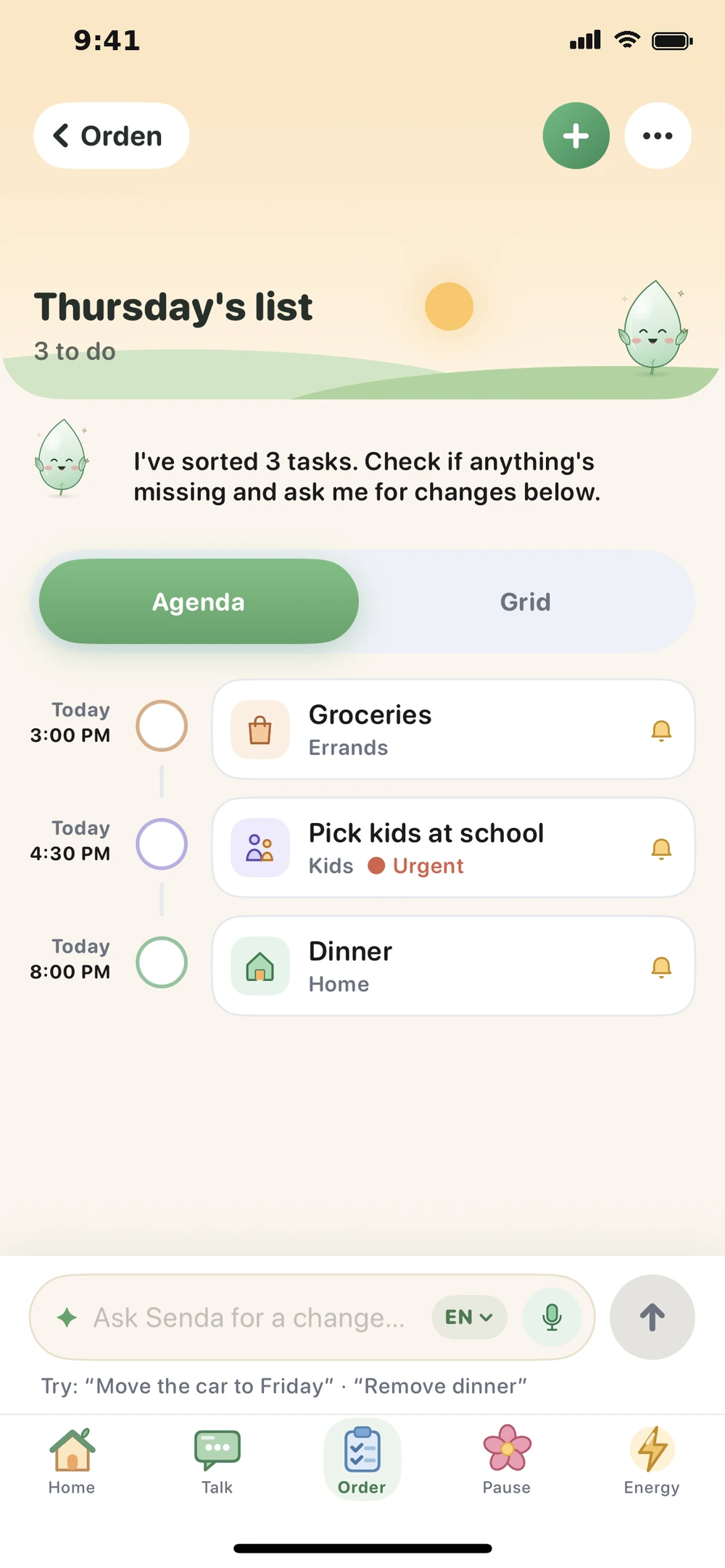
In Order, you dictate everything at once, however it comes out ("dentist Tuesday at 5, gift for Lucía, pay the gym") and Senda turns it into tasks with dates, categories and reminders. Change it just by saying so.
- Plan around your energy: Senda shows your level for the day.
- Vent in Talk when the list feels like too much.
- Protect a real break in your plan.
Free plan, no card needed. 3-day free trial.
Frequently asked questions
Why do I procrastinate when I have a lot to do?
Because a long list makes every task feel heavier and more stressful. Putting things off gives quick relief from that feeling, which is why procrastination often grows when you are overwhelmed.
How do I stop procrastinating right now?
Choose one task, turn it into a tiny next action and give it two minutes. Remove one obstacle, such as opening the document, and start before you feel ready.
Is procrastination a sign of ADHD?
Not on its own. Everyone procrastinates sometimes. If difficulty starting tasks has been lifelong and affects many areas of your life, talk to a doctor about an assessment.
Does forgiving yourself help with procrastination?
Research suggests it can. Being kind to yourself about past delays reduces the bad feeling linked to the task, which makes it easier to start again.
Sources
Keep reading


Senda is a self-care and organization companion, not a medical service. This guide is informational and does not replace advice from a qualified professional.