
In short
- Many women find it easier to do everything than to ask, because asking feels like being a burden.
- Research by Zhao and Epley found that people underestimate how willing others are to help, and how good helping makes them feel.
- Clear, specific requests work best: what, when, and that they can say no.
Why asking feels so hard
If you are used to holding everything together, asking for help can feel like admitting failure. Common thoughts: "they are busy too", "it's quicker if I do it", "I don't want to owe anyone", "they should notice without me asking".
The result is familiar: you do it all, you get tired, and resentment builds quietly.
People want to help more than you think
In a series of experiments published in 2022, psychologists Xuan Zhao and Nicholas Epley found that people asking for help underestimated how willing others would be to say yes, and how positive the helpers would feel afterwards. The barrier is often in our expectations, not in other people.
How to ask clearly
- Be specific. "Can you help more?" is vague. "Can you do bath and bedtime on Tuesdays and Thursdays?" is clear.
- Ask for ownership when it makes sense. "Can you take charge of the school forms?" means noticing, filling in and returning them.
- Give a time. "Before Friday" or "this weekend".
- Make it easy to say no. "If it doesn't work for you, no problem" lowers the pressure for both sides.
- Say thank you, not sorry. Asking is not a fault.
Phrases you can use
- With your partner: "I'm carrying too much in my head this week. Can you take over dinners until Sunday, including the shopping?"
- With family: "Could you pick the kids up from school on Wednesday? It would give me an afternoon to rest."
- With a friend: "I'm having a hard week. Would you come for a walk with me on Saturday?"
- At work: "I can do this by Thursday if someone takes the report. Can we look at priorities?"
When the answer is no
A no is information, not rejection. Thank them, and ask someone else or adjust the plan. If the answer is always no from the same person, especially at home, that is worth a calmer conversation about how the load is shared.
 How Senda helps
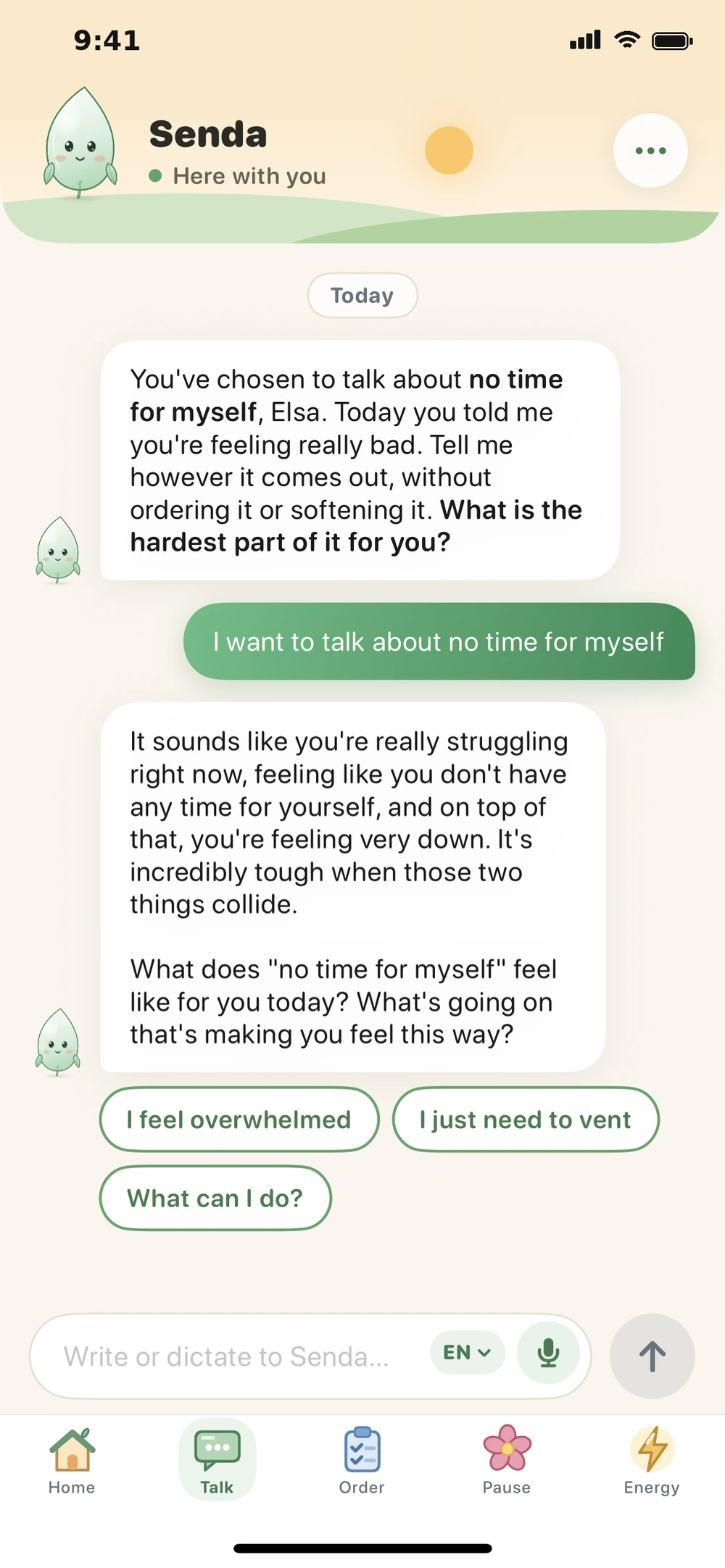
In Talk, you can say how you really are, any time, without judgment. Senda listens first and replies with your day in mind: your energy, your cycle and what is on your plate.
- Empty your head in Order: dictate everything and get a plan with dates and reminders.
- See your energy for today, so you can plan around it.
- Take a real break, from 5 minutes to 4 hours.
Free plan, no card needed. 3-day free trial.
Frequently asked questions
Why is it so hard to ask for help?
People often worry about being a burden, look weak or owe a favour. Research by Zhao and Epley found that we also underestimate how willing others are to help.
How do I ask my partner for help without arguing?
Pick a calm moment, be specific about what you need and when, ask them to take ownership of a whole area when possible, and describe how you feel rather than listing what they don't do.
How do I stop feeling guilty for asking for help?
Remember that most people are glad to help and feel good afterwards. Say thank you instead of sorry, and offer help in return when you can.
Sources
Keep reading


Senda is a self-care and organization companion, not a medical service. This guide is informational and does not replace advice from a qualified professional.