
In short
- Resentment usually isn't about one dish in the sink. It is about feeling alone with the load for a long time.
- Research links feeling solely responsible for the household with lower satisfaction with life and with the partner.
- It helps to talk about areas and the thinking work, not single tasks, and to agree on a new split you review together.
Why chores turn into resentment
It rarely starts with a big fight. It starts with small things: being the only one who notices the bins are full, the only one who remembers the school trip, the one who has to ask. Each time on its own seems minor. Together they say "this is your job", and that is what hurts.
Sociologist Allison Daminger describes the invisible part of housework as cognitive labor: anticipating, deciding and checking. A 2019 study of mothers by Ciciolla and Luthar found that feeling solely responsible for running the household was linked to feeling more empty and less satisfied with their partnership.
Signs resentment is building
- You keep a silent score of who does what.
- You snap at small things and then feel unreasonable.
- You stop asking for help because "it's easier to do it myself".
- You feel more like a manager than a partner.
- Affection and desire drop, and you're not sure why.
How to talk about it
- Pick a calm moment. Not in the middle of the mess, not at 11 p.m.
- Start with how you feel, not with a list of failures. "I've been feeling alone with running the house and it's wearing me down."
- Make the invisible visible. Write down everything that keeps the house going, including the thinking: planning meals, booking appointments, buying presents.
- Split areas, not tasks. "You own the laundry: noticing, washing, putting away" removes the reminders.
- Agree on what "done" means. Different standards are a common source of conflict. Decide together what is good enough.
- Review in two weeks. Ten minutes: what worked, what needs changing.
What to avoid
- Waiting until you explode.
- Saying "you never…" and "you always…".
- Taking back the area as soon as it's not done your way.
If it keeps going wrong
If the conversation always turns into a fight, if one of you dismisses the problem or if you feel unsafe raising it, a couples counsellor can help you find a different way to talk. If you ever feel in danger at home, contact your local emergency number or a support line.
 How Senda helps
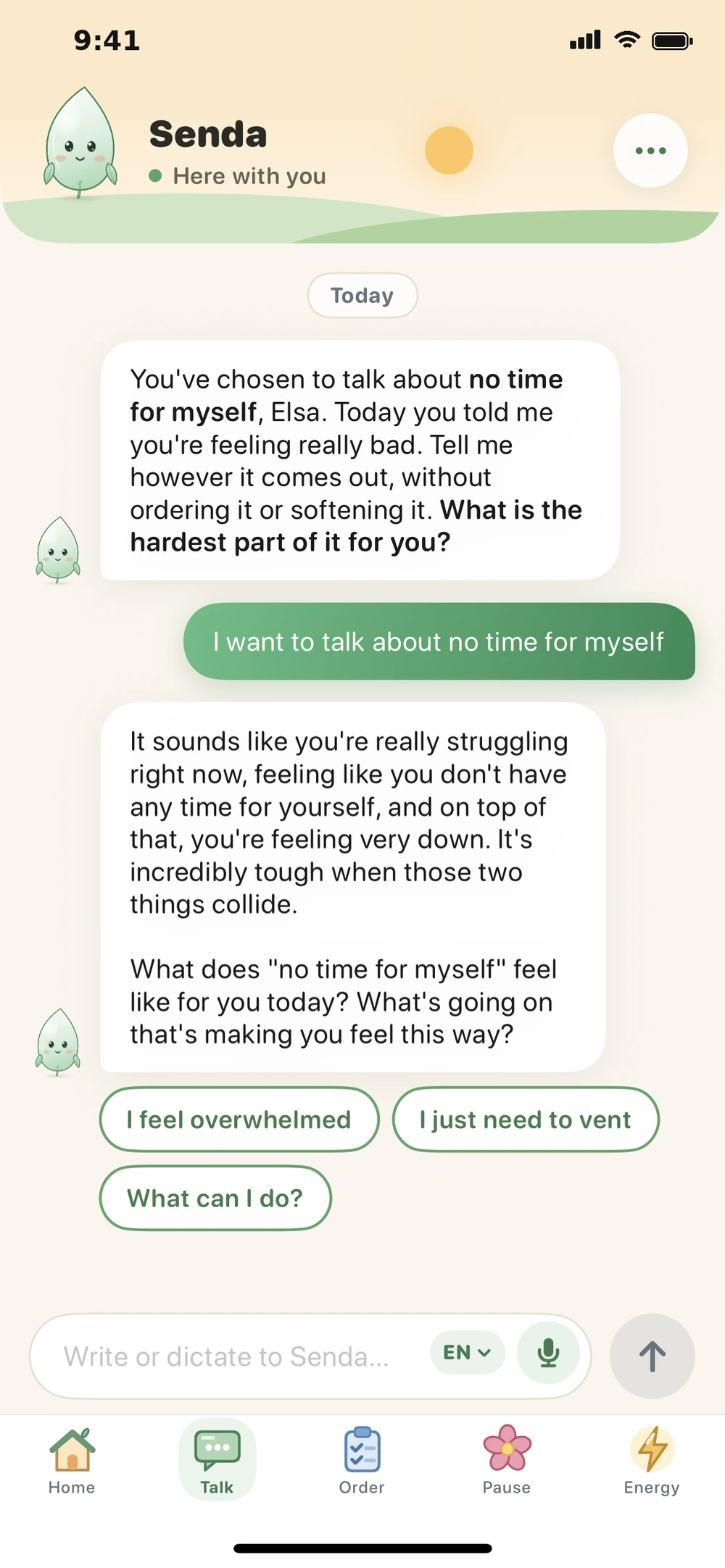
In Talk, you can say how you really are, any time, without judgment. Senda listens first and replies with your day in mind: your energy, your cycle and what is on your plate.
- Empty your head in Order: dictate everything and get a plan with dates and reminders.
- See your energy for today, so you can plan around it.
- Take a real break, from 5 minutes to 4 hours.
Free plan, no card needed. 3-day free trial.
Frequently asked questions
Is it normal to feel resentment about household chores?
Yes. It is very common when one person carries most of the work and the thinking behind it. Resentment is a signal that the split needs to change.
How do I talk to my partner about the mental load without a fight?
Choose a calm moment, start with how you feel, list everything including the invisible tasks and agree on whole areas each person owns.
How do we split chores fairly?
Split areas from start to finish, including noticing and planning, agree on what "done" means and review the split together after a couple of weeks.
Sources
Keep reading




Senda is a self-care and organization companion, not a medical service. This guide is informational and does not replace advice from a qualified professional.