

In short
- The mental load often falls on women because of habits, expectations and the "default" role, not because women are better at it.
- It is mostly invisible, so it is easy to underestimate how much it weighs.
- What helps: making it visible, sharing whole areas and protecting time that is only yours.
It is not a personal failing
If you feel you carry more of the thinking at home, you are not imagining it. Sociological research finds that in many couples, women do more of the anticipating and monitoring, even when the visible tasks are split more evenly.
Sociologist Allison Daminger describes this as cognitive labor: anticipating, identifying options, deciding and monitoring.
Why it happens
Habits from childhood
Girls are often praised for being organized, attentive and helpful. Those skills are valuable, and they also make it easy to become the person who notices everything.
The "default" role
When one person usually answers the school, books the appointments and knows the plans, everyone starts to go to her. The role becomes automatic.
Invisible work stays invisible
Planning, worrying and remembering don't leave a trace. If nobody sees it, nobody offers to share it.
Life stages add more
Pregnancy, small children, caring for parents and perimenopause can all arrive while work demands stay the same.
What actually helps
- Name it. Use the words "mental load" with your partner or family. A shared name makes it easier to discuss.
- List the invisible jobs. Write them down for a week. Seeing the list changes the conversation.
- Share ownership, not help. Whoever owns an area also remembers it.
- Let go of one standard. Choose one thing that can be "good enough" this month.
- Protect time that is only yours. Even short, regular pauses change how heavy the week feels.
The pattern in numbers, at home and at work
The same pattern shows up beyond the home. In studies published in 2017, economist Linda Babcock and colleagues found that women were asked more often than men to take on tasks with low promotability at work, such as organising, note-taking and committee work, and said yes more often. Expectations, not ability, explained most of the difference. At home, the planning and remembering often follows the same route: to the person everyone expects to say yes.
Where the load usually sits
| Area | Who often notices first | What helps |
|---|---|---|
| Children's schedules | The mother | One shared calendar with an owner per area |
| Food and shopping | The mother | Rotating weekly menu ownership |
| Family relationships (gifts, calls) | The woman | Each partner owns their own family |
| Home maintenance | Split, often by stereotype | Choose by preference and time, not gender |
| Health appointments | The mother | One person owns each child's health |
A worked example
*This is an illustrative example, not a real user.* Irene realises she buys and wraps every present for both families. She and her partner agree that each owns their own family's birthdays, including remembering, buying and sending. The first year he forgets one. Irene does not step in, and he sets a reminder for next year.
Common mistakes
- Believing you are "just better at it". Skills come from practice; others can practise too.
- Stepping in when someone else forgets. It is hard, but it keeps the load with you.
Start with one conversation
You do not need to change everything at once. Pick one area from the table, explain why it matters to you and agree who owns it from now on, including remembering. Put a date in the calendar to check how it went. Small, clear changes, repeated, are what slowly move the load.
You deserve support too
Carrying everyone's needs can make your own disappear. Saying out loud how you are, to a friend, a professional or somewhere private, is a first step back to yourself.
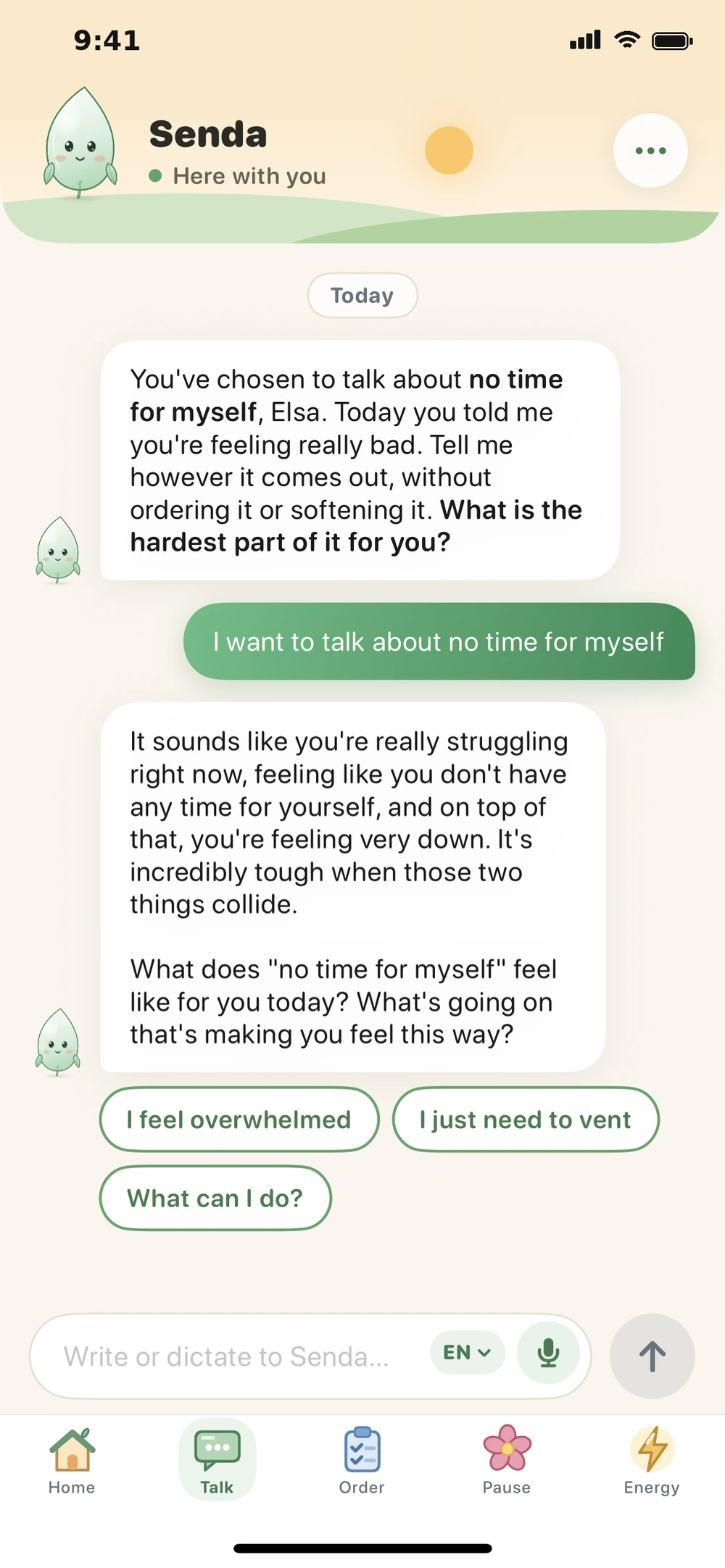
 How Senda helps
Senda was made for women who carry a lot.
- Talk about relationships, work, your body or anything else, without judgment.
- Order: dictate everything and get a plan, so it doesn't all live in your head.
- Energy and cycle: see how your sleep, your days and your cycle shape your energy, in plain words.
Free plan, no card needed. 3-day free trial.
Frequently asked questions
Why do women carry the mental load?
Upbringing, social expectations and the habit of one person being the "default" manager at home mean the planning work often falls on women, even when tasks seem shared.
Is the mental load a women's problem?
It affects anyone who manages a household alone, but research shows it falls more often on women. It is a shared problem with shared solutions.
How can I reduce my mental load as a woman?
Make the invisible work visible, share full ownership of areas, relax one standard at a time and protect regular time for yourself.
Is the mental load a gender issue?
Research suggests it often is. Studies have found that women tend to carry more of the planning and remembering at home and are asked more often to take on similar unrewarded tasks at work.
Why do women say yes to extra tasks?
Research by Babcock and colleagues suggests it is largely about expectations: people expect women to agree, so they ask them more, and women feel more pressure to accept.
Sources
- Daminger, A. (2019). The Cognitive Dimension of Household Labor. American Sociological Review
- Ciciolla, L. & Luthar, S. (2019). Invisible Household Labor and Ramifications for Adjustment. Sex Roles
- Harvard Kennedy School Gender Action Portal: Babcock, L. et al. (2017). Gender differences in accepting and receiving requests for tasks with low promotability. American Economic Review
Keep reading



Senda is a self-care and organization companion, not a medical service. This guide is informational and does not replace advice from a qualified professional.