
In short
- Decision fatigue is the drop in quality and willingness to decide after a long run of choices.
- For women who run a household, the decisions never stop: meals, schedules, gifts, forms, who picks up whom.
- You cannot remove decisions, but you can decide fewer times: defaults, routines and one planning moment a week.
What decision fatigue is
Decision fatigue describes what happens when you have made so many choices that the next ones get harder. You either put them off, pick whatever is easiest, or snap at the person who asks "what's for dinner?".
A 2020 conceptual analysis in the Journal of Health Psychology described it as a state of reduced ability to make decisions after a period of repeated decision-making, with signs such as avoiding choices, acting impulsively and feeling drained. Researchers still debate exactly how it works, but the everyday experience is familiar to almost everyone.
Why it hits so hard at home
Running a home is a stream of small decisions that nobody sees: what to cook, what is missing from the fridge, which form to sign, when to book the dentist, what to pack for the trip. Each one is small. Together they fill the day, on top of the decisions at work.
Signs it is building up
- "I don't care, you choose" becomes your answer to everything.
- Putting off easy choices like replying to a message or booking an appointment.
- Impulse decisions: ordering takeaway, buying the first thing you see.
- Irritability when someone asks one more question.
- Feeling tired even on a day without much physical effort.
How to make fewer decisions
- Create defaults. Pasta on Mondays, the same breakfast on weekdays, a fixed day for the weekly shop. A default is a decision you only make once.
- Batch decisions. Pick one moment a week to plan meals, schedules and errands, instead of deciding on the go.
- Write it down. Getting the list out of your head means you stop re-deciding the same things every time you remember them.
- Limit the options. Two outfits, three dinner ideas, one shop. Fewer options make faster choices.
- Hand over whole decisions, not tasks. "You're in charge of birthday presents this year" removes a whole category from your head.
- Decide important things early. Your energy for decisions is usually better in the morning than at 10 pm.
Turn repeated decisions into defaults
Most daily decisions repeat every week. Each one you turn into a default is one less choice to make. Use this table as a starting point and adapt it to your family:
| Repeated decision | Default you decide once |
|---|---|
| What's for dinner | A theme per night: pasta Monday, soup Tuesday, eggs Wednesday… |
| What to buy | A standing shopping list you only edit |
| Breakfast | Two options on rotation |
| Kids' clothes | Laid out the night before, chosen by them |
| Birthday presents | A short list of go-to gifts by age |
| Weekend plans | One family activity, one free afternoon |
| Who does what | Fixed owners for school, health, food and home |
A typical week, before and after
Before: Take Ana, 41, an illustrative example. She counts the decisions she makes before 9 am on a Tuesday: what to wear, what to give the kids for breakfast, whether to wash the PE kit, who drops off, what to pack for lunch, whether to answer a work email, what to buy for dinner. Seventeen decisions before her first meeting.
After two weeks with defaults (a breakfast rotation, clothes chosen at night, a fixed drop-off rota and a weekly meal plan), the morning has four real decisions left, and much more room in her head for work.
Common mistakes
- Trying to optimise every choice. Most daily decisions don't need the best option, just a good enough one.
- Planning on the go. Deciding dinner at 6 pm is the most tiring way to decide it.
- Asking "what do you want?" to the whole family. Offer two options instead of an open question.
- Making big decisions at night. If it can wait until morning, let it.
Start with one area this week
Pick the area that drains you most, often food, and decide it once for the whole week on Sunday. Our free weekly meal planner and weekly planner templates can help.
When it is more than fatigue
If you feel unable to make even simple decisions for weeks, or it comes with low mood, poor sleep or loss of interest, talk to your doctor. Constant difficulty deciding can be a sign of stress or depression rather than simple tiredness.
 How Senda helps
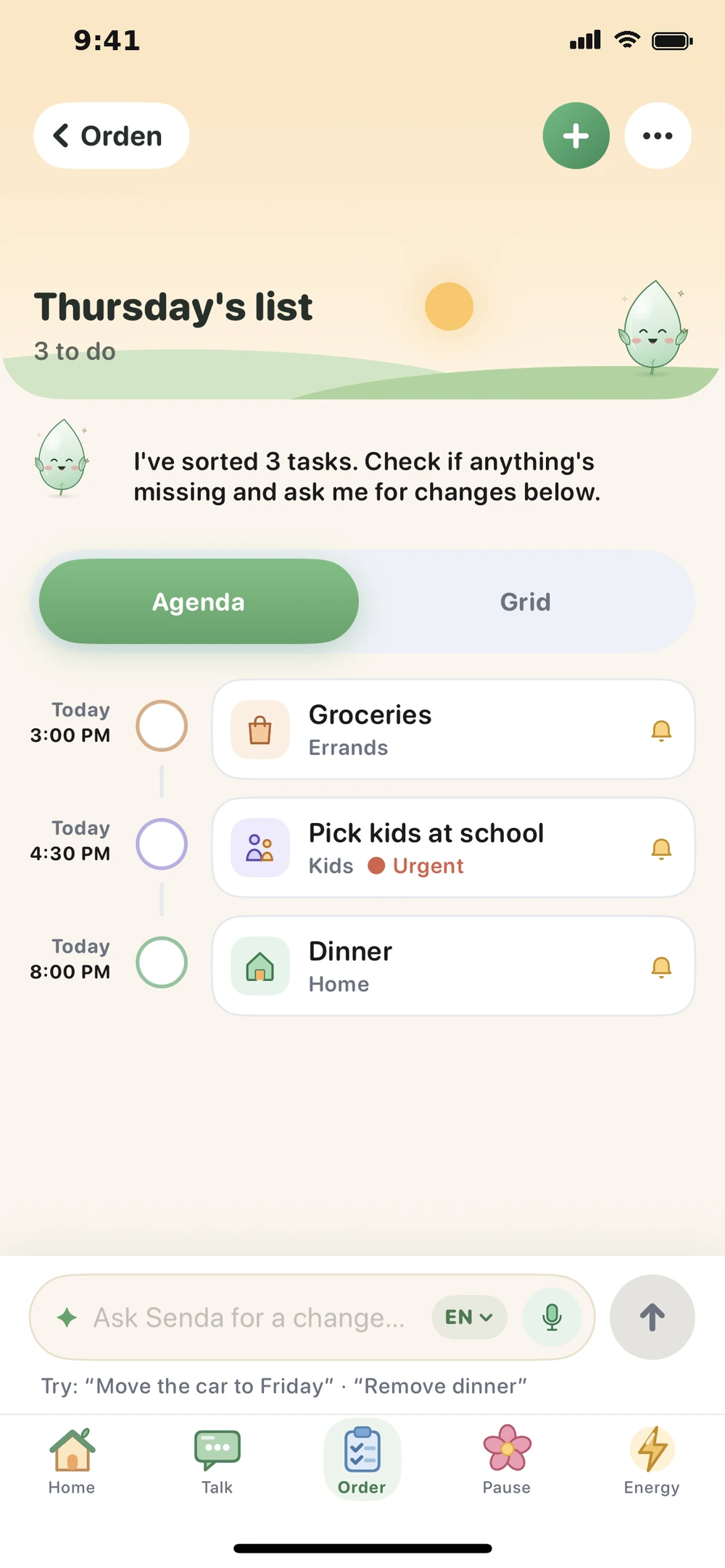
In Order, you dictate everything at once, however it comes out ("dentist Tuesday at 5, gift for Lucía, pay the gym") and Senda turns it into tasks with dates, categories and reminders. Change it just by saying so.
- Plan around your energy: Senda shows your level for the day.
- Vent in Talk when the list feels like too much.
- Protect a real break in your plan.
Free plan, no card needed. 3-day free trial.
Frequently asked questions
What are the symptoms of decision fatigue?
Common signs are avoiding or putting off simple choices, making impulsive decisions, irritability when asked to choose, and feeling drained after a day of many small decisions.
How do you reduce decision fatigue?
Make fewer decisions: set defaults and routines, plan meals and schedules once a week, write things down, limit your options and hand over whole areas of responsibility to someone else.
Is decision fatigue real?
It is a widely used idea and many people recognise it. Researchers still debate the exact mechanism, so treat it as a useful way to understand mental tiredness rather than a diagnosis.
Why do I feel exhausted after making lots of small decisions?
Each choice takes attention, and when decisions pile up without breaks they can feel draining. Reducing the number of choices with routines and defaults usually helps.
Does decision fatigue affect women more?
Research has not shown a clear difference by sex, but women who carry most of the household planning make many more small decisions each day, which can add to the feeling of mental fatigue.
Sources
Keep reading




Senda is a self-care and organization companion, not a medical service. This guide is informational and does not replace advice from a qualified professional.