

In short
- Perfectionism is not about high standards. It is about feeling that anything less than perfect is a failure.
- Research by Curran and Hill found that perfectionism has increased in young people since the late 1980s.
- You can practise "good enough" with small, safe experiments, and notice that nothing terrible happens.
What perfectionism looks like
Perfectionism rarely looks like a spotless house. More often it looks like:
- Redoing things that were already fine.
- Putting things off because you can't do them perfectly yet.
- Replaying mistakes for days.
- Doing it yourself because others won't do it "right".
- Never feeling finished, even after a good day.
Having high standards can be healthy. Perfectionism is different: your worth depends on getting it right, so every task carries a threat.
Why it is so common
A 2019 meta-analysis by psychologists Thomas Curran and Andrew Hill, covering more than 40,000 college students in the US, Canada and the UK, found that perfectionism increased between 1989 and 2016, especially the feeling that others expect you to be perfect. Social media, comparison and the pressure to do well in every role make it easy to feel you are never quite enough.
For many women, perfectionism shows up across every role at once: the perfect professional, mother, partner, friend and daughter.
What it costs you
- Time: hours spent polishing things nobody notices.
- Energy: the constant checking is tiring.
- Rest: you can't relax while something is "not done properly".
- Help: if only you can do it right, you end up doing everything.
Small experiments with "good enough"
- Pick one low-risk task and do it at 80%: an email you don't reread three times, a dinner that is simply fine.
- Set a time limit before you start. When the time is up, it is done.
- Let someone else do it their way and don't fix it afterwards.
- Notice what happens. Usually: nothing bad. Write it down so you remember.
- Talk to yourself like a friend. Would you tell her that her work is a failure?
When to get support
If perfectionism comes with constant anxiety, low mood, or rituals you can't stop, a psychologist can help. Approaches such as cognitive behavioural therapy are often used for perfectionism.
 How Senda helps
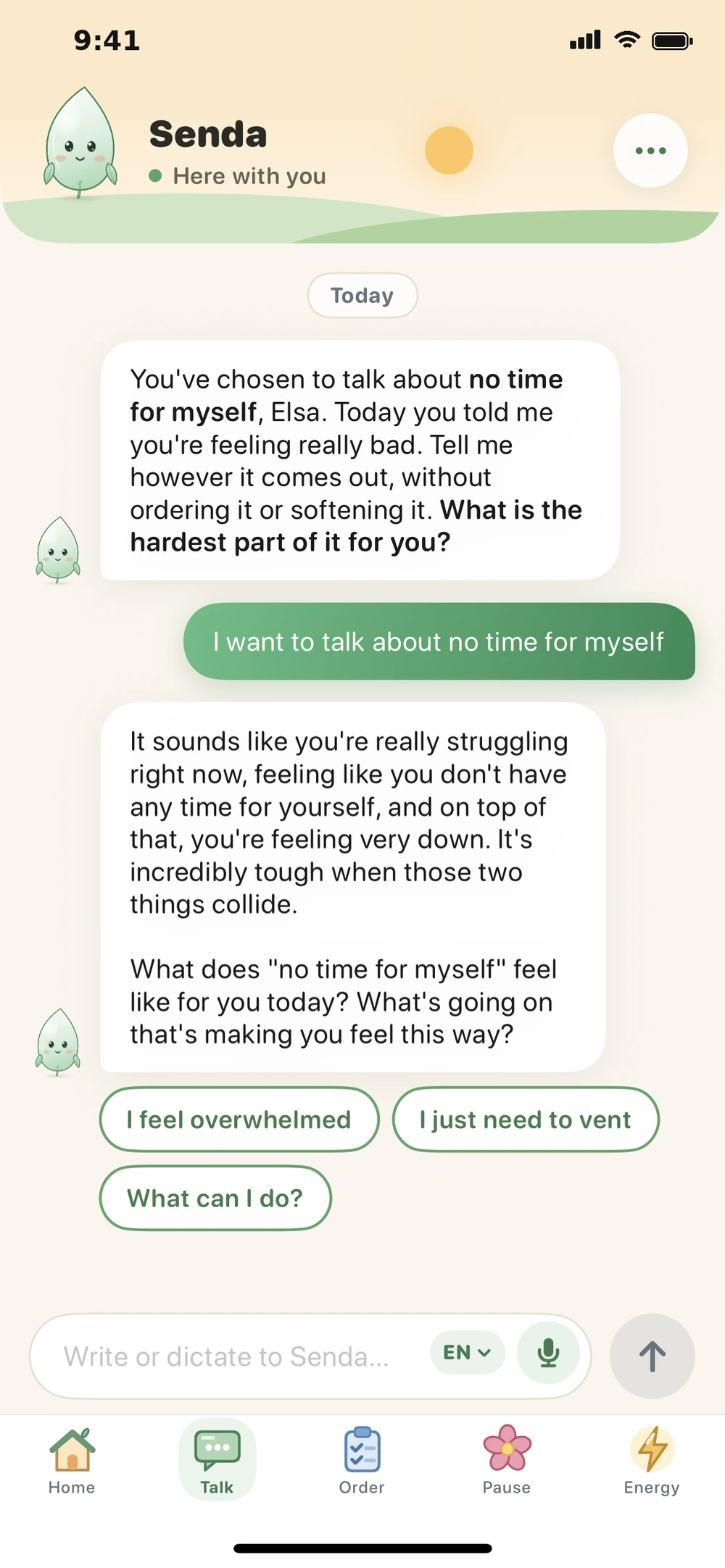
In Talk, you can say how you really are, any time, without judgment. Senda listens first and replies with your day in mind: your energy, your cycle and what is on your plate.
- Empty your head in Order: dictate everything and get a plan with dates and reminders.
- See your energy for today, so you can plan around it.
- Take a real break, from 5 minutes to 4 hours.
Free plan, no card needed. 3-day free trial.
Frequently asked questions
What is the difference between high standards and perfectionism?
High standards push you to do well and let you feel satisfied. Perfectionism makes anything less than perfect feel like failure, so you rarely feel finished or satisfied.
How do I stop being a perfectionist?
Practise "good enough" in small, low-risk tasks: set time limits, let others do things their way and notice that nothing bad happens. If it causes constant anxiety, talk to a professional.
Is perfectionism increasing?
Yes, according to a 2019 meta-analysis by Curran and Hill, which found that perfectionism rose among college students in the US, Canada and the UK between 1989 and 2016.
Sources
Keep reading


Senda is a self-care and organization companion, not a medical service. This guide is informational and does not replace advice from a qualified professional.