
In short
- Office housework is work that keeps the team running but rarely gets you promoted: notes, birthdays, onboarding, organising.
- A 2017 study found women were asked more often, and said yes more often, to these tasks.
- The fix is not doing nothing: it is rotating, saying no well and making your main work visible.
What office housework is
Office housework is the set of tasks that keep a workplace running but rarely appear in your performance review. Taking the notes in a meeting. Organising the team lunch. Buying the leaving present. Onboarding the new person. Booking rooms, chasing everyone for the report, being the one everyone asks "where is that file?". Some people call it "glue work" or non-promotable tasks.
These tasks matter. Someone has to do them. The problem is when the same people always do them, and it costs them time for the work that does get noticed and rewarded.
What research found
Economists Linda Babcock, Maria Recalde, Lise Vesterlund and Laurie Weingart studied who volunteers for and who gets asked to do low-promotability tasks. In a series of studies published in 2017 in the American Economic Review, women were more likely than men to volunteer, more likely to be asked and more likely to say yes when asked. The researchers concluded that the difference came largely from expectations: everyone, women and men, expected women to say yes.
If you also carry most of the mental load at home, office housework can feel like the same pattern following you to work: noticing what needs doing, organising others and keeping everyone happy.
Common examples
| Task | Why it is easy to land on you |
|---|---|
| Taking meeting notes | "You write so clearly" |
| Organising celebrations and gifts | "You're so good at this" |
| Onboarding new colleagues | You are kind and patient |
| Booking rooms and calendars | You noticed it was not done |
| Chasing people for deadlines | You care about the result |
| Mentoring juniors informally | They come to you, so you help |
How to share it more fairly
- Track it for two weeks. Write down every non-core task you do and how long it takes. Data makes the conversation easier.
- Propose a rotation. Notes, social events and onboarding can rotate across the team, written in a shared calendar.
- Pause before volunteering. In the silence after "Can someone…?", count to five. Someone else may step in.
- Say no with a reason and an alternative. "I took the notes the last three times. Could someone else take them today?"
- Trade, do not just accept. "I can organise onboarding if I drop the weekly report formatting."
- Make it visible when you do it. Mention it in one-to-ones and reviews, with the time it takes.
- Talk to your manager about the system, not just your case. A fair process helps everyone.
A worked example
*This is an illustrative example, not a real user.* Lucía tracks her week and finds four hours of note-taking, birthday cards and helping new hires with the systems. She brings the list to her one-to-one and suggests a rotation for notes and celebrations. Her manager agrees, and asks Lucía to keep onboarding as a recognised part of her role, with time set aside for it and a mention in her goals.
Common mistakes
- Doing it quietly and then resenting it. Invisible work stays invisible unless you name it.
- Refusing everything. Some glue work is valuable. The goal is fairness and recognition, not zero.
- Apologising for saying no. A short, friendly no is enough.
- Fixing it alone. It is a team pattern, so the solution works best as a team agreement.
Read next: Working from home with kids: a realistic plan for focus, breaks and less guilt
When it is affecting your health
If you feel constantly overloaded, cannot switch off and feel exhausted or cynical about work, it may be more than unfair task sharing. The World Health Organization describes burn-out as the result of chronic workplace stress that has not been successfully managed. Talk to your doctor if the exhaustion lasts.
 How Senda helps
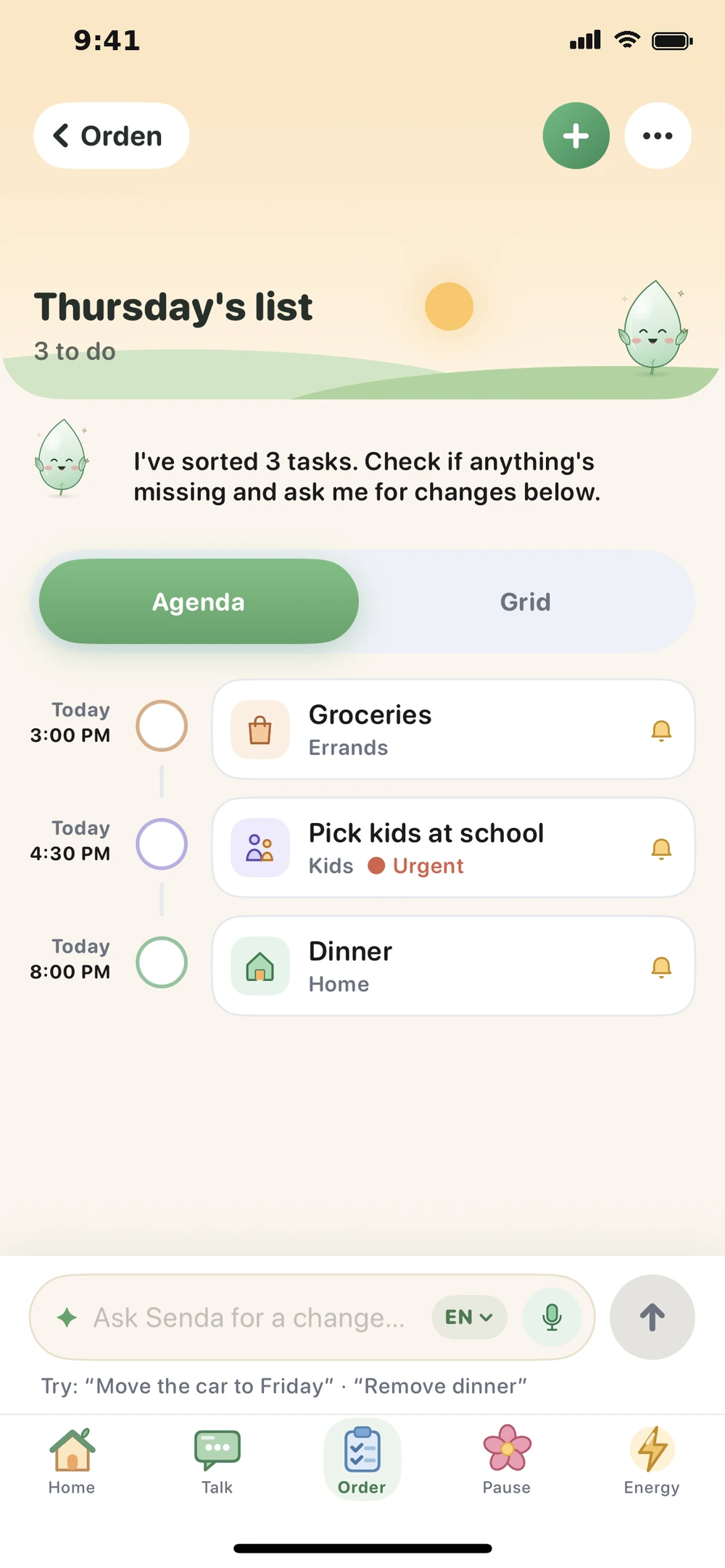
In Order, you dictate everything at once, however it comes out ("dentist Tuesday at 5, gift for Lucía, pay the gym") and Senda turns it into tasks with dates, categories and reminders. Change it just by saying so.
- Plan around your energy: Senda shows your level for the day.
- Vent in Talk when the list feels like too much.
- Protect a real break in your plan.
Free plan, no card needed. 3-day free trial.
Frequently asked questions
What is office housework?
Office housework is work that keeps the team running but is rarely rewarded, such as taking notes, organising celebrations, onboarding new colleagues, booking rooms and chasing deadlines.
Why do women do more office housework?
Research by Babcock and colleagues found women were asked more often and said yes more often to low-promotability tasks, mainly because of shared expectations that women will agree.
How do I say no to office housework?
Give a short reason and an alternative, such as "I took the notes the last three times, could someone else take them today?", and propose a rotation for repeating tasks.
What are non-promotable tasks?
Tasks that benefit the organisation but are unlikely to count towards your performance review or promotion, such as committee work, event planning and informal help.
Sources
Keep reading




Senda is a self-care and organization companion, not a medical service. This guide is informational and does not replace advice from a qualified professional.